



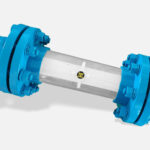
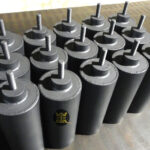
Electrochemical and Cathodic Protection Systems
Custom MMO, platinized, and specialty coated titanium anodes for brine electrolysis, sodium hypochlorite generation, electrowinning, water treatment, and impressed current cathodic protection. Built to your drawing, verified batch by batch.
What Is a Titanium Anode?
The definition, and why the coating decides most of the performance.
A titanium anode is an insoluble electrode made of a titanium substrate carrying a catalytic coating on its working surface. The titanium base, normally Grade 1 or Grade 2 per ASTM B265, supplies mechanical strength and corrosion resistance. The coating supplies the electrocatalytic activity. Because the substrate keeps its dimensions in service, these electrodes are also known as dimensionally stable anodes (DSA), a term first used for coated titanium electrodes in chlor-alkali cells.
The right coating lowers cell voltage and extends service life. The wrong coating in the same cell raises energy consumption and can fail early. That is why we size every quotation around four inputs: your electrolyte chemistry, your current density, your operating temperature and pH, and your target service life.
Choose a Titanium Anode by Coating Chemistry
Coating selection follows the anodic reaction. Below are the four systems we run in production.
Ruthenium-Iridium MMO Anodes
Chlorine evolution duty. The standard coating for brine electrolysis, electrochlorination, chlor-alkali cells, and sodium hypochlorite generators.
Best ForSeawater and brine service, 2 to 3% NaCl hypochlorite systems, on site disinfection.
Typical FormsMesh, plate, tubular, rod.
Iridium-Tantalum MMO Anodes
Oxygen evolution duty. Stable in acidic electrolytes and under polarization, which makes it the default coating for cathodic protection anodes.
Best ForICCP systems, water treatment, electrowinning, acidic sulfate electrolytes.
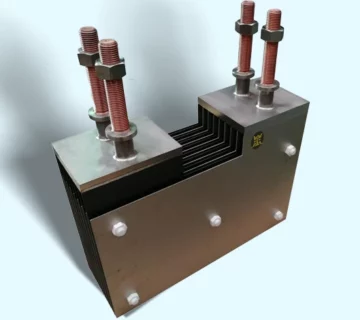
Typical FormsTubular, ribbon, mesh, plate, canister assemblies.
Platinized Titanium Anodes
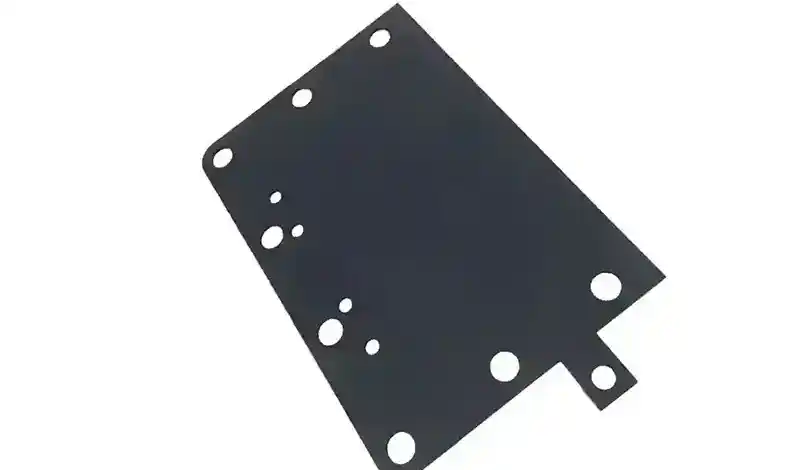
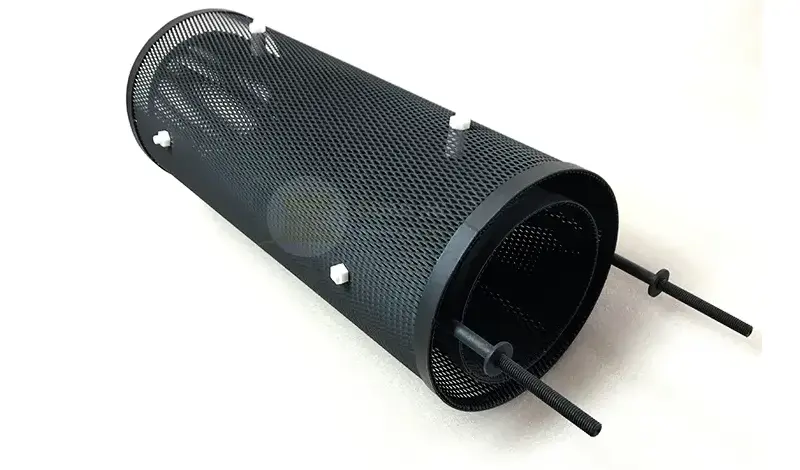
A platinum layer, typically 2.5 to 10 microns, on titanium. Low consumption rate and stable potential in precision electroplating.
Best ForPCB plating, precious metal plating, laboratory cells, cathodic protection in fresh water.
Typical FormsMesh, rod, wire, tube, custom shapes.
Titanium Anode Forms and Custom Structures
Geometry controls current distribution and installation. We manufacture all standard forms plus welded assemblies to drawing.
| Form | Best For | Customization |
|---|---|---|
| Mesh anodes | High surface area, even current distribution, compact cells | Expanded or woven, framed panels, any width and length |
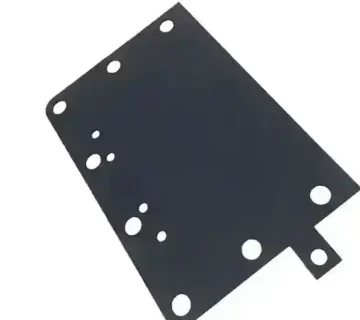
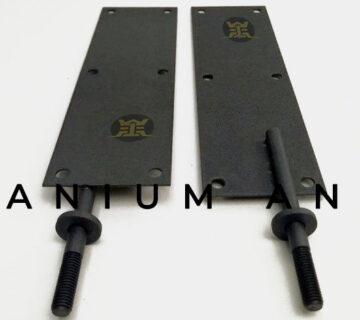
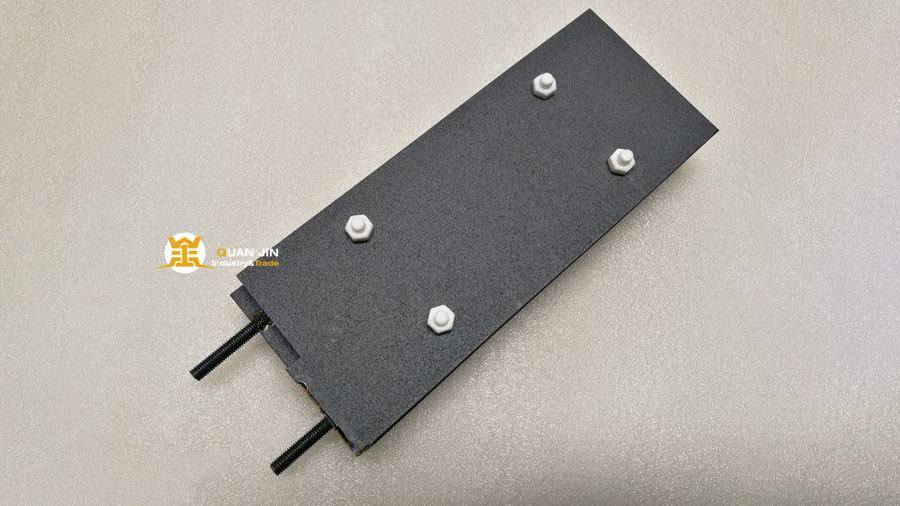
| Plate anodes | Flat cells, electrowinning, water treatment tanks | Thickness and cut to size, welded or bolted lugs |
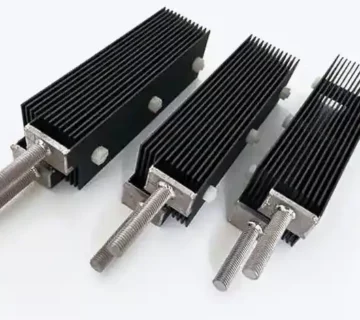
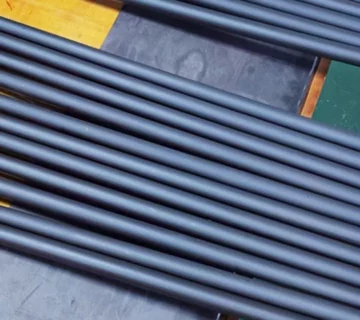
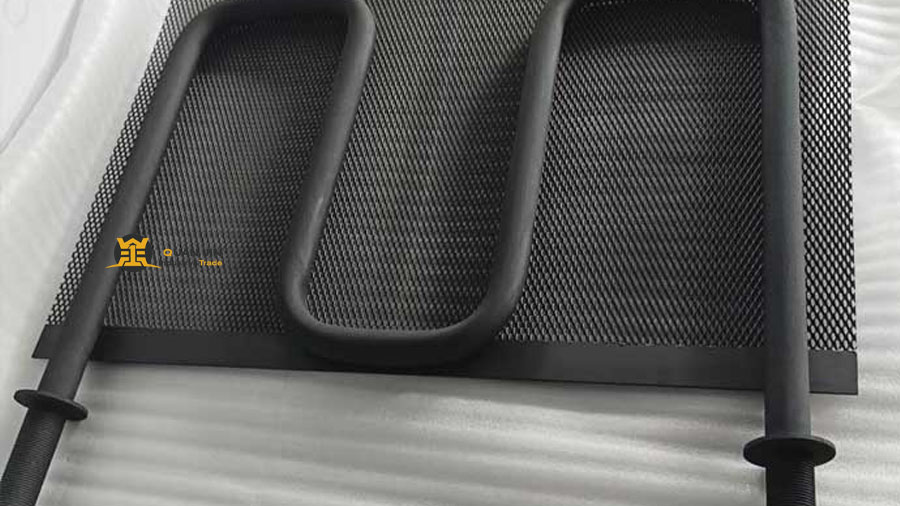
| Tubular anodes | Cathodic protection, deep well groundbeds, marine structures | Diameter, length, cable connections, canister packing |
| Rod anodes | Compact systems, laboratory and pilot cells | Diameter, length, threaded ends |
| Ribbon anodes | Rebar corrosion control in concrete, tank bottoms | Conductor bar spacing, connection kits |
| Wire and coil anodes | Small electrolyzers, on site testing | Diameter, coil form, pigtail connections |
| Disc anodes | Laboratory work, sensors, rotating electrodes | Diameter and thickness to drawing |
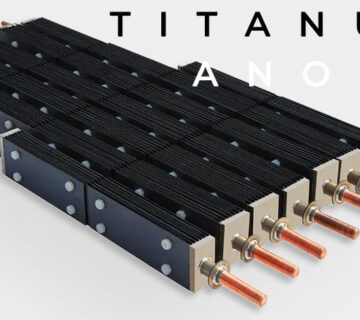
| Custom assemblies | OEM electrolyzers, retrofit parts, prototype runs | Welded frames, copper cored bars, insulator mounts |
Plan Titanium Anodes by Application
Each application pulls a specific coating and form. These are the duties we quote most often.
- Sodium Hypochlorite Generation
On site generators running 2 to 3% brine. Ru-Ir MMO mesh, plate, or tubular anodes sized to the generator’s current rating. - Electrochlorination and Seawater
Marine growth prevention and ballast water treatment. Coatings selected for seawater chemistry and intermittent duty. - Cathodic Protection (ICCP)
Impressed current anodes for pipelines, tanks, marine structures, and concrete. Ir-Ta MMO tubular, ribbon, and mesh systems. - Electrowinning and Metal Recovery
Copper, nickel, cobalt, and zinc winning. Coated titanium anodes as the lead-free alternative for acidic sulfate electrolytes. - Electrolytic Copper Foil
Dimensionally stable anodes for foil forming and surface treatment lines, including curved and segmented geometries. - Chlor-Alkali and Brine Electrolysis
Ru-Ir and iridium based coatings for chlorate, chlorite, and chlorine service, matched to membrane and diaphragm cell designs. - Water and Wastewater Treatment
Electro-oxidation and disinfection electrodes for industrial effluent, landfill leachate, and process water polishing. - Electroplating and PCB
Platinized titanium anodes and MMO auxiliary anodes for printed circuit board plating lines and general metal finishing.
Titanium Substrate Selection
The substrate carries the coating and the current. Two grades cover almost every anode we ship.
| Property | Grade 1 Titanium | Grade 2 Titanium |
|---|---|---|
| Character | Higher purity, highest formability | General industrial grade |
| Best used for | Expanded mesh, deep drawn and complex formed parts | Plates, rods, tubes, welded assemblies |
| Standard | ASTM B265 (sheet and plate) | ASTM B265, B338 (tube), B348 (bar) |
| Role in the anode | Conductor and structural base; forms the stable passive film the coating anchors to | Same |
Substrates are inspected on arrival for grade verification, dimensional accuracy, and surface condition before they enter the coating line. Material test certificates can travel with each shipment.
From Titanium Substrate to Finished Anode
Four controlled stages decide whether an anode reaches its design life.
1. Substrate preparation.
Grade verification, forming and welding to drawing, then degreasing and acid etching to activate the surface for coating adhesion.
3. Assembly and connection.
Welding of lugs, copper cored bars, or cable connections, then electrical continuity checks across every joint.
2. Coating and thermal decomposition.
Brush or spray application of precious metal salt solutions, followed by drying and oxidation at controlled temperature, repeated layer by layer.
4. Testing and documentation.
XRF coating loading in g/m2, adhesion tape and bend tests, dimensional inspection, and batch records assembled for shipment.
Quality Assurance for Coated Titanium Anodes
What we check, and what you receive on paper with each batch.
| Check | Method and Purpose |
|---|---|
| Substrate verification | Grade and batch traceability against the material test certificate |
| Dimensional inspection | Measured against the approved drawing before and after coating |
| Surface preparation check | Etch quality reviewed before the first coating pass |
| Coating loading (XRF) | Verified in g/m2 and recorded per batch |
| Adhesion testing | Tape peel and bend tests on sample pieces from each run |
| Electrical continuity | Resistance measured across welded connections and conductor bars |
| Accelerated life test (on request) | Sample coupons run at elevated current density in 1M H2SO4 or 1M NaOH for batch to batch comparison |
| Shipment documentation | Material test certificate, XRF report, dimensional and visual inspection records, packing list |
What Affects Titanium Anode Cost
Six variables drive the quotation. Knowing them helps you compare offers on equal terms.
Coating chemistry
Ruthenium based systems cost less than iridium based systems. Platinum coatings are quoted by micron thickness.
Precious metal loading
Higher loading in g/m² means longer life at a given current density, and a proportionally higher price.
Form and dimensions
Mesh, plate, tube, and custom welded assemblies differ in forming and welding labor.
Current density and life target
A higher current density duty needs a heavier coating to reach the same life, or a shorter life at the same loading.
Connections and assembly
Copper cored bars, cable assemblies, and insulator mounts add material and labor.
Testing and documentation
ALT runs, third party inspection, and project specific QC packages are quoted as options.
Procurement insight: the lowest anode price is not always the lowest operating cost. Energy consumed per tonne of product, change-out labor, and downtime usually outweigh the purchase price over the anode’s life.
Why Buyers Source Titanium Anodes from Quan jin
Factory direct manufacturing in Baoji, China, the country’s titanium production hub.
- Factory direct
Anodes are coated in our own line, so coating parameters and batch records are under our control, not a subcontractor’s. - Multiple coating systems
Ru-Ir, Ir-Ta, platinized, and specialty coatings from one supplier, which simplifies sourcing across projects. - Made to drawing
Standard forms plus custom welded assemblies, from single prototypes to recurring production batches. - Application based engineering
Coating and geometry are selected from your operating data, not from a stock list. - Documented quality
XRF loading reports, adhesion tests, and inspection records available with every shipment. - Export experience
Experience shipping to industrial buyers in North America, Europe, and Southeast Asia, with export grade packing.
Titanium Anodes Compared with Graphite and Lead Anodes
Why most electrochemical plants have moved away from carbon and lead electrodes.
| Property | Coated Titanium Anode | Graphite Anode | Lead Alloy Anode |
|---|---|---|---|
| Dimensional stability | Stable in service | Erodes and thins | Deforms under load |
| Consumption | Coating consumption measured in mg per year | Anode mass consumed continuously | Anode mass consumed continuously |
| Product purity | No substrate metal in the product | Carbon particles shed into the cell | Lead contamination risk in the product |
| Current density | Handles high current density duty | Limited by erosion rate | Limited by passivation |
| Weight and handling | Light titanium structure | Heavy and brittle | Heavy, toxic handling rules apply |
| Purchase price | Higher upfront | Low | Low to moderate |
| Lifecycle cost | Lower where energy and change-outs matter | Higher once erosion and downtime count | Higher where lead removal is required |
Frequently Asked Questions About Titanium Anodes
What is a titanium anode?
A titanium anode is an insoluble electrochemical electrode built from a titanium substrate with a catalytic coating on the working surface. The titanium, usually Grade 1 or Grade 2 per ASTM B265, gives the anode its strength and corrosion resistance. The coating, such as mixed metal oxide (MMO) or platinum, drives the anodic reaction. Because the titanium base stays dimensionally stable during operation, these electrodes are also called dimensionally stable anodes (DSA).
What is the difference between a titanium anode and an MMO anode?
Titanium anode is the general term for any coated titanium electrode. MMO anode is one type within that family, where the coating is a mixed metal oxide layer of precious metal oxides such as ruthenium and iridium. Other titanium anode types include platinized titanium and lead dioxide coated titanium. In practice, buyers who ask for MMO anodes usually need a Ru-Ir or Ir-Ta coated titanium electrode for chlorine or oxygen evolution duty.
Which coating should I choose for chlorine evolution and which for oxygen evolution?
For chlorine evolution, choose a ruthenium-iridium MMO coating. It is the standard choice for brine electrolysis, electrochlorination, and sodium hypochlorite generation. For oxygen evolution, choose an iridium-tantalum MMO coating, which resists acidic electrolytes and holds up in water treatment, electrowinning, and cathodic protection service. If you are not sure which reaction dominates in your cell, send us the electrolyte composition and we will confirm the coating.
What titanium grade is used for anode substrates?
Grade 1 and Grade 2 titanium per ASTM B265 are the standard substrate grades. Grade 1 has higher purity and better formability, so it is used for expanded mesh and deep drawn parts. Grade 2 is the general industrial grade for plates, rods, and tubes. Both grades form the stable oxide film that makes titanium an effective base for coated anodes.
What shapes of titanium anodes are available?
Common forms include mesh, plate, tubular, rod, ribbon, wire, and disc anodes, plus custom welded assemblies. Mesh suits cells that need high surface area and even current distribution. Plate suits flat cell geometries and electrowinning. Tubular and ribbon anodes are standard in cathodic protection. We manufacture to your drawing, including copper cored conductors, threaded connections, and insulator mounts.
How is coating quality verified before shipment?
Coating loading is verified by XRF analysis and reported in g/m2. Adhesion is checked with tape peel and bend tests. Every batch receives dimensional inspection and a visual surface review. Accelerated life testing (ALT) can be run on sample coupons under agreed conditions, for example 1M H2SO4 or 1M NaOH at elevated current density, to compare coating batches on a like for like basis. Shipping documents can include the material test certificate, XRF report, and inspection records.
What information should I provide when requesting a quotation?
Send the application, electrolyte composition, operating current density, temperature, pH, target service life, anode dimensions and shape, and required connection method. A drawing in PDF, STEP, or DWG format speeds up the review. With these inputs we can confirm the coating system and quote within 48 hours.
Can worn titanium anodes be recoated?
Yes. If the titanium substrate is intact, the old coating can be stripped and the anode recoated at a lower cost than a new part. We inspect returned anodes first, then quote stripping, surface preparation, recoating, and testing. Substrates that are thinned, warped, or corroded beyond limits are not good candidates for recoating.
What is accelerated life testing (ALT)?
ALT is a laboratory test that runs an anode sample at a current density far above its normal operating level, for example 20,000 A/m2 in 1M H2SO4 or 1M NaOH, until the coating fails. Because failure time shortens as current density rises, the test compares coating systems and production batches against each other in days instead of years. ALT results are comparative, not a direct prediction of service life in your cell.
Tell Us About Your Cell. We Will Confirm the Coating.
Send your electrolyte, current density, temperature, target life, and anode drawing. We reply with a coating recommendation and quotation within 48 hours. Files up to 10 MB in PDF formats are accepted.