



Titanium Electrodes: A Complete Guide to MMO, DSA, and Platinized Anodes
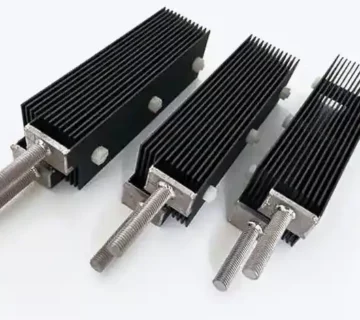
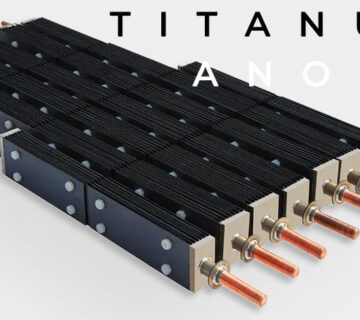
A titanium electrode is an insoluble electrochemical electrode built from a titanium base, usually Grade 1 or Grade 2 per ASTM B265, with a thin catalytic coating on the working surface. The coating does the electrochemistry; the titanium supplies the strength, the corrosion resistance, and the dimensional stability. Depending on the process, that coating is a mixed metal oxide (MMO), platinum, or lead dioxide. Titanium electrodes run in chlor-alkali plants, sodium hypochlorite generators, electroplating lines, electrolytic copper foil production, wastewater treatment, and impressed current cathodic protection, often for years between change outs.
Key facts at a glance
- Substrate: Grade 1 or Grade 2 titanium per ASTM B265
- Main coating families: Ru-Ir MMO (chlorine evolution), Ir-Ta MMO (oxygen evolution), platinum (precious metal plating), lead dioxide (high potential oxidation)
- Typical current density: 100 to 3,000 A/m² in most processes; 7,000 to 10,000 A/m² in electrolytic copper foil production
- Typical service life: 2 to 10 years at rated conditions, depending on the duty
- Global market: about USD 605 million for titanium-based MMO anodes in 2025, forecast to reach roughly USD 800 million by 2032
What Is a Titanium Electrode?
A titanium electrode is an anode made of a titanium substrate and a thin electrocatalytic layer. The substrate is usually commercially pure titanium, Grade 1 or Grade 2, which stays passive in chloride, sulfate, and most acid and alkali electrolytes. The catalytic layer, applied at high temperature, carries the oxygen or chlorine evolution reaction that the process needs.
Why does the coating exist? Bare titanium forms a dense passivating oxide film in an electrolyte. That film blocks current, so an uncoated titanium anode stops working at normal cell voltages. The coating provides a conductive, catalytically active surface that keeps the cell running at a predictable voltage.
Titanium electrodes belong to a family called dimensionally stable anodes (DSA). The name says it all: unlike graphite anodes that burn away and lead anodes that dissolve and deform, a coated titanium anode holds its geometry through the life of the coating. That stable geometry keeps the anode to cathode gap constant, which keeps current distribution even and cell voltage predictable.


Why Titanium?
Titanium is the substrate of choice for one reason: it survives environments that destroy other metals.
- Corrosion resistance. Titanium resists chloride pitting, sulfuric acid, and caustic, which is exactly the chemistry found in chlor-alkali, brine electrolysis, and acid sulfate plating.
- A self-healing passive film. When the surface is scratched, a new titanium oxide film forms instantly and passivates the exposed metal.
- Dimensional stability. The substrate does not dissolve during electrolysis, so the anode keeps its shape and the cell keeps its gap.
- Light weight. Titanium weighs about 40 percent less than a comparable lead alloy anode, which cuts handling and installation cost.
- A reusable base. When the coating wears out, the titanium can be stripped and recoated instead of scrapped.
Types of Titanium Electrodes
Three coating families cover most industrial service: mixed metal oxide (MMO), platinum, and lead dioxide. MMO coatings dominate the market, which is why you will also hear the terms DSA and MMO used for the same product.
Coating systems compared
| Coating system | Catalyzes | Best suited for | Notes |
|---|---|---|---|
| Ru-Ir MMO (ruthenium and iridium oxides with TiO₂) | Chlorine evolution | Chlor-alkali, sodium hypochlorite generators, seawater electrochlorination | Low chlorine overpotential, high current density |
| Ir-Ta MMO (iridium and tantalum oxides) | Oxygen evolution | Electrowinning, electrolytic copper foil, acid sulfate plating, wastewater oxidation | Resists oxidative dissolution in acid |
| Ir-Sn MMO (iridium and tin oxides) | Oxygen evolution | Electro-oxidation of organic wastewater | Stable in aggressive organic loads |
| Platinum (Pt) | Both, with high stability | Precious metal plating, some water electrolysis, cathodic protection | 1 to 5 µm electrodeposited; 25 to 125 µm clad |
| Lead dioxide (PbO₂) | Oxygen evolution at high potential | Wastewater electro-oxidation, ozone, perchlorate synthesis | Oxygen evolution overpotential about 1.8 V vs SHE |
MMO coatings are applied as thin oxide layers, typically 5 to 20 µm, with precious metal loadings of 5 to 20 g/m² in standard service and more when the target life is long. Ru-Ir coatings are formulated for chlorine evolution; Ir-Ta coatings are formulated for oxygen evolution in acid. Platinum coatings are applied by electrodeposition (1 to 5 µm) or by cladding (25 to 125 µm) and are used where the bath must stay free of any metal contamination. Lead dioxide on titanium is a niche product for high potential oxidation, with an oxygen evolution overpotential around 1.8 V vs SHE, which is why it is used to mineralize refractory organics and to generate ozone and strong oxidants.
How Coated Titanium Electrodes Are Made
Five steps produce a coated titanium electrode:
- Substrate machining. Grade 1 or Grade 2 titanium is cut, stamped, or formed into plates, mesh, tubes, rods, ribbons, discs, or custom assemblies per customer drawings.
- Surface preparation. The surface is sandblasted to roughen it, then cleaned in multi stage acid pickling and ultrasonic baths to remove grease and oxide. The roughness is what the coating grips.
- Coating application. Noble metal precursor solutions are applied by brush, roller, or spray in controlled layers.
- Thermal decomposition. The coated part is sintered in a furnace at 400 to 450 °C in repeated cycles. Each cycle converts the precursors into a dense, conductive mixed oxide that bonds to the titanium.
- Inspection and testing. Batches are checked for coating adhesion, thickness (measured by X-ray fluorescence), uniformity, and electrochemical performance. Representative samples run an accelerated life test (ALT) so the supplier can estimate service life under your duty.
The result is a coating that is part of the surface, not a paint on it. That is why coated titanium anodes survive thermal cycling and mechanical handling without delaminating.
Where Titanium Electrodes Are Used
| Application | Recommended coating | Typical operating window |
|---|---|---|
| Chlor-alkali (chlorine and caustic soda) | Ru-Ir MMO | Brine electrolyte, high current density, 60 to 90 °C |
| Sodium hypochlorite generation | Ru-Ir MMO | 1,000 to 3,000 A/m², 3 to 6 V, 3 to 5 percent brine or seawater, 10 to 60 °C |
| Electroplating (nickel, copper, zinc, hard chromium) | Ir-Ta MMO in sulfate baths; platinized titanium for precious metals | 100 to 2,000 A/m², up to 60 °C |
| Electrolytic copper foil | Ir-Ta MMO | 7,000 to 10,000 A/m², 50 to 60 °C, Cu²⁺ 50 to 150 g/L, H₂SO₄ 60 to 150 g/L, chloride 30 to 60 ppm |
| Electrowinning (copper, zinc, manganese) | Ir-Ta MMO | Acidic sulfate baths |
| Wastewater electro-oxidation | Ir-Ta, Ir-Sn MMO, or PbO₂ | High COD loads, refractory organics |
| Impressed current cathodic protection (ICCP) | Ir-Ta MMO | Soil, seawater, low current density, decades of life |
| Water electrolysis for hydrogen | Ir-based MMO | PEM and alkaline cells |
Application notes
Sodium hypochlorite generation. On-site hypochlorite generators electrolyze brine or seawater to make disinfectant where it is used, which removes the transport and storage of liquid bleach or chlorine gas. The Ru-Ir coating is chosen for its low chlorine overpotential and stable output in chloride service. Typical cells run at 1,000 to 3,000 A/m² and 3 to 6 V, and anodes are rated for 5 to 10 years under normal conditions.
Electrolytic copper foil. Copper foil for lithium ion batteries and printed circuit boards is grown on a rotating cathode drum, and the anode sits opposite the drum in a copper sulfate bath. Ir-Ta coated titanium anodes handle the oxygen evolution duty at 7,000 to 10,000 A/m². Because the anode keeps its dimensions, the anode to cathode gap stays constant across the drum, which is what keeps foil thickness uniform. Bath conditions are tight: copper 50 to 150 g/L, sulfuric acid 60 to 150 g/L, chloride 30 to 60 ppm, fluoride below 1 ppm, temperature 50 to 60 °C. Anodes typically run about 8 to 12 months in this duty, then the titanium is stripped and recoated.
Wastewater treatment. Electrochemical oxidation generates hydroxyl radicals at the anode surface that break down dyes, pharmaceuticals, and other refractory organics that biological treatment cannot handle. Ir-Ta and Ir-Sn MMO coatings handle this duty at moderate cost. For the hardest loads, lead dioxide on titanium provides the high oxygen evolution overpotential needed to mineralize organics completely.
Chlor-alkali. Chlor-alkali plants make chlorine and caustic soda from brine. Ru-Ir MMO anodes replaced graphite and mercury electrodes in this industry decades ago, and they remain the standard because of their low chlorine overpotential and long life in saturated brine.
Cathodic protection. Impressed current cathodic protection (ICCP) systems protect pipelines, ship hulls, and offshore structures. Anodes buried in soil or submerged in seawater operate at low current density, where Ir-Ta MMO coatings can last for decades.
How to Choose the Right Titanium Electrode
The coating choice follows the electrolyte, not the brand. Four questions decide it:
- What reaction does the cell need? Chlorine or hypochlorite production points to a ruthenium based coating. Oxygen evolution in acid points to an iridium based coating.
- What is the electrolyte chemistry? High chloride means ruthenium iridium MMO. Sulfate or nitrate with continuous oxygen evolution means iridium tantalum MMO. Fluorides above 20 ppm attack the titanium substrate, so tell the supplier before ordering.
- What are the operating limits? Current density, temperature, and pH set the coating loading and the expected life. Halving the current density can multiply coating life by 3 to 5 times.
- What geometry fits the cell? Plates for flat cells, mesh for circulation and gas release, tubes for cylindrical cells, rods for compact units. The supplier can build to drawing.
Decision steps at a glance
| Condition | Coating to choose |
|---|---|
| Chloride-rich electrolyte, chlorine or hypochlorite target | Ru-Ir MMO |
| Acidic sulfate or nitrate, continuous oxygen evolution | Ir-Ta MMO |
| Organic wastewater with high COD | Ir-Sn MMO or PbO₂ |
| Precious metal plating, bath purity critical | Platinized titanium |
| Electrolyte contains fluorides | Talk to the supplier; may need special substrate treatment |
Service Life and Maintenance
Service life is set by the duty, and the biggest lever is current density. Run the cell at the rated current density. Doubling the current density roughly halves the coating life, and halving it can extend life by 3 to 5 times.
Maintenance checklist
- Keep fluoride below 20 ppm in the electrolyte (below 1 ppm in copper foil baths). Fluorides dissolve the titanium substrate.
- Never reverse polarity. MMO anodes run as anodes; cathodic polarization strips the coating within hours.
- Hold temperature inside the rating, usually below 60 °C for aqueous cells.
- Watch cell voltage. A slow rise in voltage at constant current is the first sign of coating wear.
- Clean the surface of scale and deposits at scheduled stops.
- Keep the coating free of scratches and impact.
When the coating reaches end of life, recoat instead of replacing. Recoated anodes cost 30 to 50 percent less than new ones because the titanium base is reused, and the base usually outlasts several coating cycles.
Frequently Asked Questions
What is a titanium electrode?
A titanium electrode is an insoluble anode made from a titanium substrate, usually Grade 1 or Grade 2 per ASTM B265, coated with a thin electrocatalytic layer of mixed metal oxides, platinum, or lead dioxide. The titanium provides corrosion resistance and dimensional stability; the coating carries the electrochemical reaction. Titanium electrodes are used in chlor-alkali production, sodium hypochlorite generation, electroplating, electrowinning, electrolytic copper foil, wastewater treatment, and cathodic protection.
What is the difference between MMO and DSA anodes?
None. The two terms describe the same product from different angles. DSA, short for dimensionally stable anode, emphasizes that the anode holds its dimensions during electrolysis. MMO, short for mixed metal oxide, describes the coating chemistry. Most suppliers use the terms interchangeably.
Which coating should I choose, ruthenium iridium or iridium tantalum?
If the electrolyte is chloride-rich and the target reaction is chlorine or hypochlorite production, choose ruthenium iridium (Ru-Ir) MMO. If the cell runs in acidic sulfate or nitrate media with continuous oxygen evolution, choose iridium tantalum (Ir-Ta) MMO, because iridium resists oxidative dissolution far longer than ruthenium in that duty. Rule of thumb: chlorine service means Ru, oxygen service in acid means Ir.
How long does a titanium anode last?
Under rated conditions, 2 to 10 years depending on the process. Sodium hypochlorite anodes commonly run 5 to 10 years; electrolytic copper foil anodes run about 8 to 12 months in that demanding duty, then get recoated. Actual life depends on current density, temperature, electrolyte impurities such as fluorides, and how the cell is operated.
Can a titanium anode be recoated?
Yes. When the coating reaches end of life, the titanium substrate is stripped of the old coating and recoated with a fresh layer. Recoated anodes cost 30 to 50 percent less than new ones, and the substrate usually survives several coating cycles.
What is platinized titanium used for?
Platinized titanium is a titanium anode with a platinum layer, applied by electrodeposition at 1 to 5 µm or by cladding at 25 to 125 µm. It is used in precious metal plating baths (gold, silver, platinum group metals), alkaline copper plating, and some water electrolysis cells, where bath purity and stable anodic behavior matter more than cost.
Need a titanium electrode built for your cell?
Send us your electrolyte composition, current density, temperature, pH, and required dimensions. We will confirm the coating system and loading, and send a quotation within 48 hours.