



MMO/Ti flexible linear anodes · impressed current cathodic protection
Flexible Linear Anode for Cathodic Protection of Pipelines and Tank Bottoms
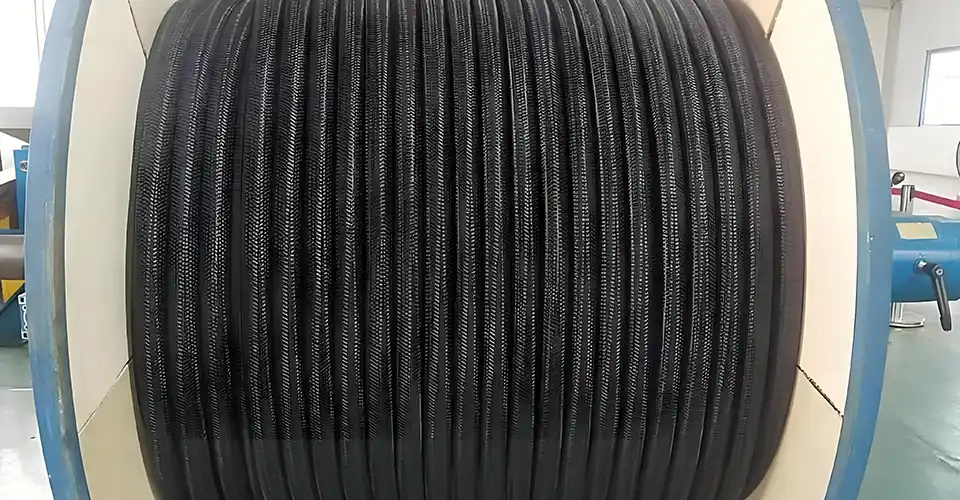
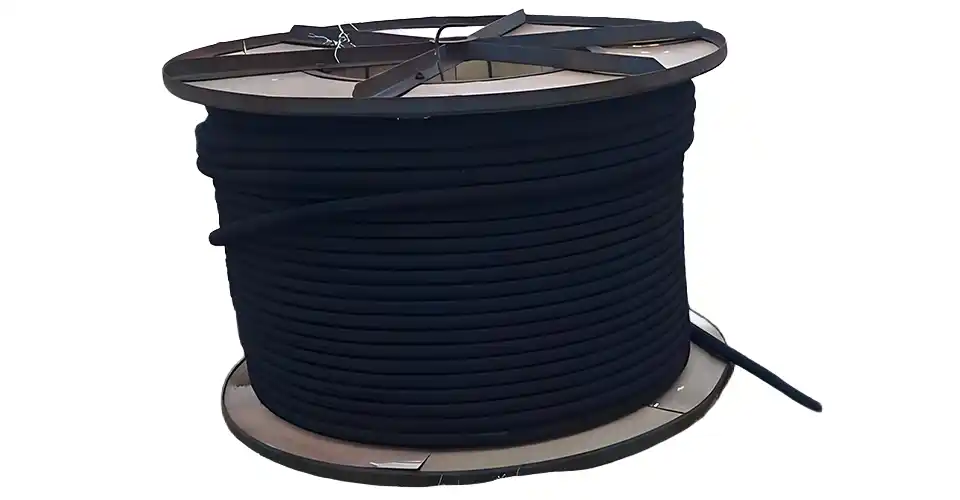
An MMO/Ti flexible anode is a continuous, cable-style anode that runs alongside the structure it protects. Instead of pushing current through a kilometer of soil from a single groundbed, it releases current evenly along its full length — so the far end of a pipeline and the center of a tank bottom get the same protection as the near end. Each meter is a Grade-1 titanium wire coated with IrO₂/Ta₂O₅ mixed metal oxide, prepacked in a conductive coke-breeze sock. Standard output is 52 mA/m with a 25-year design life; higher-output and longer-life options are available.
What makes a flexible anode different
A conventional groundbed is a point source: one anode, or a small row of anodes, pushing current across a wide area of soil. That works fine on open rights-of-way, and poorly almost everywhere else.
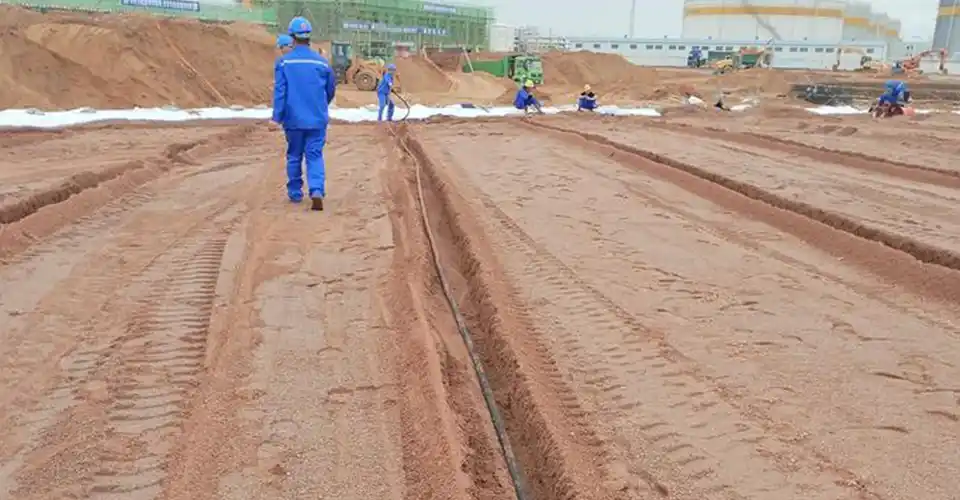
Flexible linear anodes were developed for exactly the cases where discrete groundbeds fall short. Because the anode is a continuous cable laid in the same trench as the pipe — or in a serpentine under a tank bottom — the current path to the steel is short and even. There are no dead zones at the far end of the line, no areas where a coating holiday sits outside the protective range, and no reliance on low-resistivity soil to carry current.
That close spacing also changes the electrical picture. With the anode sitting close to the structure, the anode-to-soil gradient stays small, which means less stray current reaching neighboring utilities and less risk of interference complaints on congested rights-of-way. On retrofits under existing tank bottoms, the cable can be installed by horizontal directional drilling without excavating the floor — something a rigid anode cannot do.
Most of our orders fall into two categories: new pipeline construction where the spec asks for distributed current, and tank-bottom or congested-network retrofits where a discrete groundbed physically cannot fit.
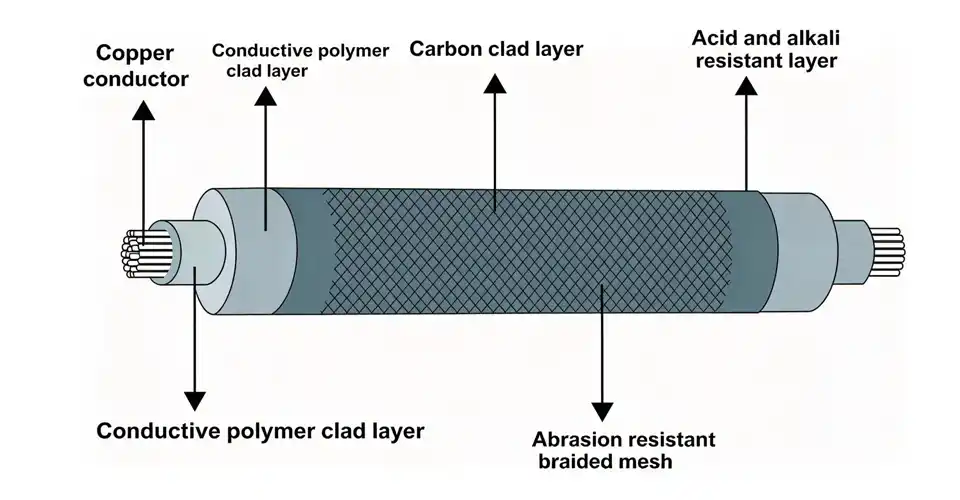
-
-
Uniform current, no dead zones
Current discharges continuously along the cable, so coverage does not taper off at the far end the way it does with a point groundbed.
-
Close-coupled, low gradient
Laid beside the pipe or beneath the tank, the anode keeps the current path short and the anode gradient small.
-
25 year design life
Rated at 25 years at maximum output, tested per NACE TM108-2012. Up to 50 years available when output is derated.
-
Low consumption rate
Noble-metal oxide loading ≥ 8 g/m² with consumption ≤ 6 mg/A·yr — the coating, not the titanium, is the working surface.
- Works in hard soil
The prepacked coke breeze gives each meter its own low-resistance discharge path — no remote groundbed needed in rocky, dry or permafrost ground. -
Kind to neighbors
Low anode gradient means less stray current on adjacent utilities — a real advantage in congested urban rights-of-way.
-
Installs fast, on reels
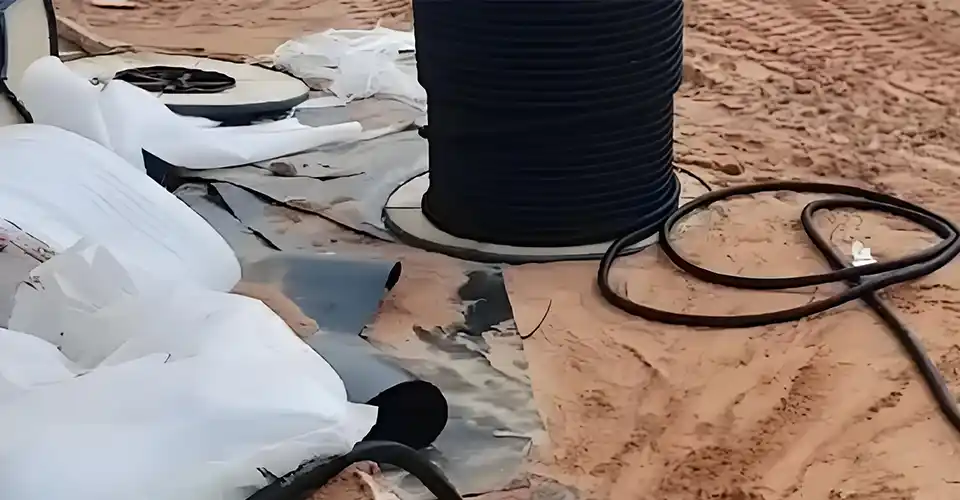
100–500 m per reel, laid by hand or trencher. No casing, no deep drilling, no backfill mixing on site.
-
Built to your CP design
Wire diameter, output, cable type, connectors and splice kits are selected from your current-output and life requirements.
-
How it works in the field
The anode is one half of an impressed current system. The rectifier feeds DC to the anode, and the anode discharges it into the soil, where it travels to the protected steel and returns to the rectifier. Where the anode sits decides how evenly that current arrives.
Technical specifications
Standard values below cover most projects. Wire diameter, current output and design life are matched to your CP design before we quote.
| Parameter | Standard | Custom options |
|---|---|---|
| Anode substrate | Grade-1 titanium wire, per ASTM B 863 | Grade-2 titanium on request |
| Wire diameter | 1.0 mm / 1.5 mm / 3.0 mm | Selected by current-output target |
| MMO coating | IrO₂ / Ta₂O₅ mixed metal oxide, loading ≥ 8 g/m² (6 g/m² minimum) | Coating recipe tuned for soil or seawater service |
| Current output | 52 mA/m at 25-year design life (1.0 mm wire) | Up to 300 mA/m with 3.0 mm wire; output derated for longer life |
| Design life | 25 years at maximum output | 40–50 years with derated output |
| Outer diameter | 38–40 mm (coke-breeze sock) | — |
| Backfill | Calcined coke breeze, carbon content ≥ 98.5%, prepacked in porous fabric sock | Sock material and mesh selected for your backfill |
| Consumption rate | ≤ 6 mg/A·yr of noble-metal oxide | — |
| Cable / conductor | 10 mm² stranded copper, HMWPE insulation | Halar or PVC insulation; 16–35 mm² conductor |
| Minimum bending radius | ≈ 500 mm — hand-laid in trench or coil | Tighter radii per project test |
| Length per reel | 100 m / 250 m / 500 m | Continuous lengths to 1,200 m |
| Reference standards | NACE TM108-2012 (performance test), ISO 15589-2 (pipeline CP), GB/T 33637-2025 (MMO/Ti flexible anode), ASTM B 863 | |
Where flexible anodes earn their keep
Any asset where a remote groundbed cannot cover the whole structure — physically, electrically, or on the budget sheet.
- Buried oil & gas pipelines
Urban rights-of-way, casings, river crossings and horizontal directional drilling sections where a discrete groundbed cannot be sited. - Storage tank bottoms
Aboveground tanks, new and retrofit, including serpentine layouts under secondary containment with no excavation of the floor. - Dense pipe networks
Plants, terminals, compressor stations and airport apron networks where dozens of lines share a narrow corridor. - High-resistivity ground
Rocky, dry, sandy or permafrost soil where a remote groundbed simply will not push current far enough. - Rehabilitation projects
Repolarizing aging coated pipelines and tanks where the coating is degraded but the asset cannot be taken out of service for long. - Concrete & marine structures
Conductive-polymer flexible anodes for reinforced concrete and jetty utilities, specified separately from the MMO/Ti soil type.
Export orders, done the way contractors expect
We ship to CP contractors, EPC firms and engineering houses. Every order leaves with documents your inspector will actually accept.
Made to your specification
- Wire diameter and current output matched to your CP design
- Copper conductor and insulation (HMWPE, Halar, PVC) to your cable spec
- Factory-installed cable-to-anode connections, splice kits and test-lead kits
- Custom length per reel and jointing plan for continuous runs
Quality control before shipment
- Coating loading and current-output per meter tested batch by batch
- Factory test certificates, material certificates and MSDS with every order
- Photo and video record of final inspection on request
Packaging and logistics
- Reels strapped, film-wrapped and crated for container or break-bulk
- Laydown and lifting plan included with the packing list
- Mixed loads with MMO tubular anodes, ribbon anodes and rectifiers
- Sea, air or land freight arranged to your port or site
Support after the sale
- Installation guide and handling instructions in PDF
- Technical answers from engineers who build anodes, not just sell them
- Spare connectors, splice kits and cable available for years after delivery
- Lead time for standard specs: 15–30 days from drawing approval
Minimum order quantity is confirmed against your specification — typical export orders start at 500 m.
Frequently Asked Questions
What is a flexible anode used for?
A flexible linear anode is an impressed-current anode used in cathodic protection. It is a continuous cable laid close to the protected structure — along a buried pipeline or beneath an aboveground storage tank — that discharges protective current evenly along its full length. It is specified where discrete groundbeds cannot provide uniform coverage: congested pipe networks, tank bottoms, high-resistivity soil and retrofit projects.
What current output do you supply per meter?
Standard output is 52 mA/m on 1.0 mm wire at 25-year life. Higher outputs up to 300 mA/m are available with 1.5 mm and 3.0 mm wire, and output can be derated where a longer design life matters more.
Can it be retrofitted under an existing tank bottom?
Yes. Because the anode is a flexible cable, it can be installed beneath an operating tank by horizontal directional drilling or sleeving, without excavating the tank floor. Serpentine layouts under secondary containment are a standard retrofit configuration.