


2000 g/h
Rated chlorine production
6000 to 8000 ppm
Available chlorine
24 hours
Automatic continuous duty
Water treatment technical guide
2 kg/h Electrolytic Sodium Hypochlorite Generator: A Complete Technical Guide
How a fully automatic brine electrolysis system turns salt, water and electricity into 2000 grams of available chlorine per hour, safely and on site.
2000 g/h
Rated chlorine production
6000 to 8000 ppm
Available chlorine
24 hours
Automatic continuous duty
On site generation of sodium hypochlorite is one of the most reliable ways to disinfect drinking water, groundwater and process water. It removes the transport hazards of chlorine gas and the instability of commercial bleach, and it produces a fresh, strong disinfectant exactly where it is needed.
This guide covers the design and operation of a 2 kg/h electrolytic sodium hypochlorite generator, model QX-CL-2000-NaCLO. It explains the design basis, the international standards applied, the complete system architecture, the key technical specifications, and the site conditions required for safe installation and operation.
1.What Is an Electrolytic Sodium Hypochlorite Generator?
An electrolytic sodium hypochlorite generator produces sodium hypochlorite solution from salt, water and electricity. Inside the electrolytic cell, a direct current passes through a dilute brine solution. Chloride ions are oxidized at the anode to form dissolved chlorine, which reacts with water to produce hypochlorous acid and hypochlorite ions. The result is a clear, pale yellow solution carrying 6000 to 8000 ppm of available chlorine.
Sodium hypochlorite is a broad spectrum oxidant. It inactivates bacteria, viruses and algae, and it oxidizes dissolved iron, manganese and odour causing compounds. Because the solution is made on site and stored for only a short time, there is no need to transport, handle or store chlorine gas or bulk commercial bleach.
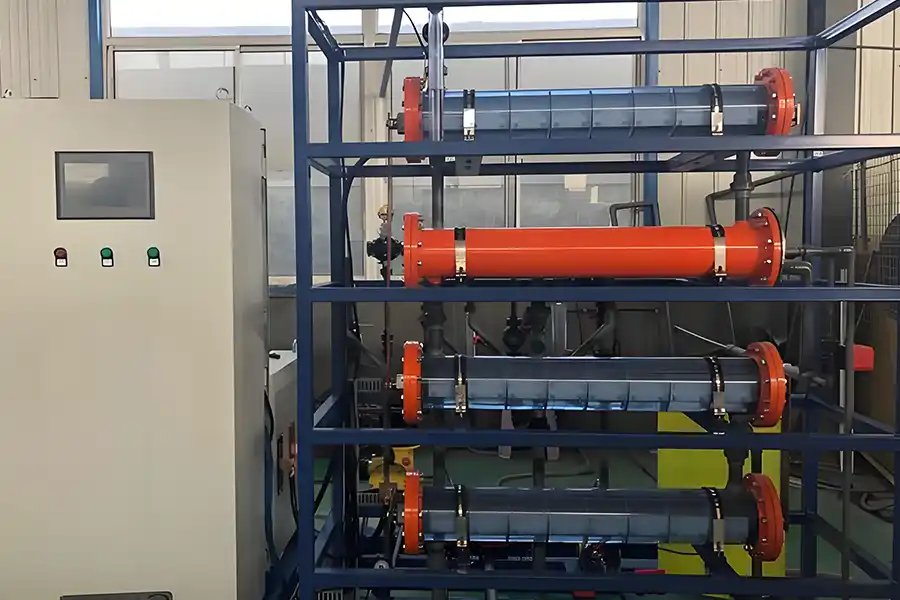
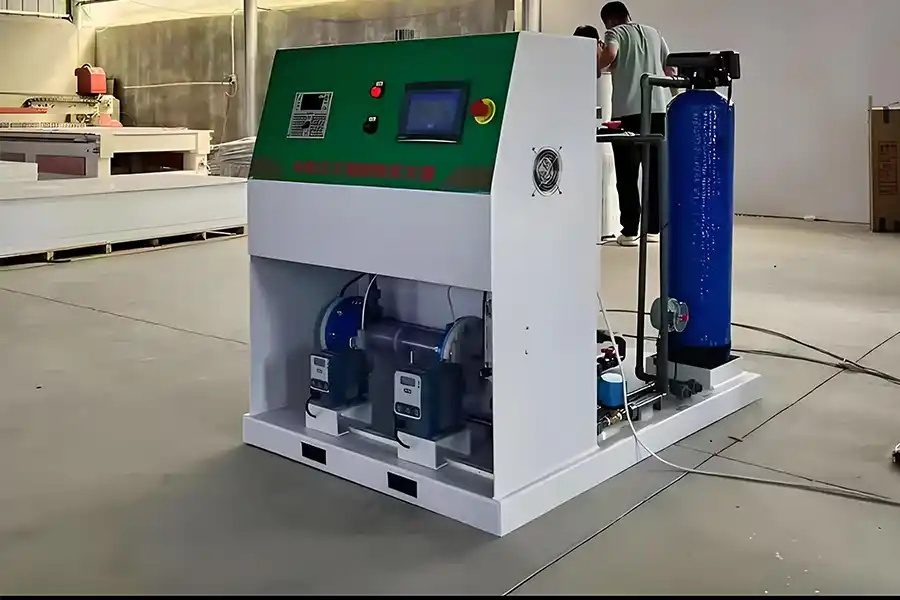
A complete generation system combines eight functional groups: water softening, salt dissolving and filtration, saturated brine metering, dilute brine mixing, the electrolytic cell assembly, rectifier power, an automatic control centre, and solution storage with dosing.
2.Design Basis and Selection
The generator is rated for a chlorine production of 2000 g per hour (2 kg/h) per main unit. The capacity is selected from the actual water demand of the project and the required chlorine dose.
For groundwater sources, the design dose is 1 to 2 mg/L of free chlorine (1 to 2 ppm). The dosing pump follows the plant flow signal, and the control centre adjusts the dose in a closed loop, so the residual chlorine stays stable even when the flow changes.
The system is designed for fully automatic, low attention operation around the clock. Routine work is limited to refilling salt, checking the solution level and periodic electrode cleaning.
3.International Standards and Compliance
The original design referenced Chinese national standards. In this guide, each standard is mapped to an international equivalent selected by functional scope: manufacturing quality, water quality, drainage design, equipment safety, chemical conformity, vocabulary and hydrogen safety.
| Design area | Original Chinese standard | International equivalent applied |
|---|---|---|
| Manufacturing and fabrication quality | JB 2932-1995, Technical conditions for the manufacture of water treatment equipment | ISO 9001:2015 quality management systems; NSF/ANSI 61 for components in contact with drinking water |
| Source and treated water quality | GB 3838-2002, Environmental quality standards for surface water | WHO Guidelines for Drinking Water Quality, 4th edition incorporating the 1st addendum |
| Outdoor drainage and sewer design | GB 50101-2005, Code for design of outdoor drainage | EN 752:2017, Drain and sewer systems outside buildings |
| Generator safety and hygiene | GB 28233-2011, Safety and hygiene standard for sodium hypochlorite generators | NSF/ANSI 60, drinking water treatment chemicals (health effects); EN 15074:2014 for sodium hypochlorite; IEC 61010-1 for electrical safety |
| Generator performance and electrical safety | GB/T 12176-1990, Sodium hypochlorite generators | IEC 61010-1 and UL 61010-1, safety requirements for electrical equipment; NSF/ANSI 60 for chemical conformity |
| Water quality vocabulary | GBJ 125-89, Standard for basic terms of water supply and drainage design | ISO 6107, Water quality. Vocabulary |
| Hydrogen safety in generator rooms | National code limit of 3% hydrogen by volume | IEC 60079-10-1 (below 25% of the lower flammability limit) and NFPA 2, Hydrogen Technologies Code |
Mapping note. The equivalents are matched by scope of application and do not imply identical clauses. For hydrogen, 25% of the lower flammability limit of hydrogen (4% by volume) equals 1% by volume, which the system uses as its design ceiling.
4.Key Technical Specifications
| Parameter | Value | Note |
|---|---|---|
| Rated chlorine production | 2000 g/h (2 kg/h) | Per main unit |
| Brine concentration | 3.0% to 5.0% | Dilute brine feed |
| Available chlorine concentration | 6000 to 8000 ppm | mg/L in product solution |
| DC power consumption | Below 4.0 kWh/kg Cl2 | Electrolysis only |
| Electrolyte flow rate | 2500 L/h | Per main unit |
| Operation mode | Fully automatic, 24 hour continuous | Low attention duty |
| Ambient temperature range | -10 to 50 °C | Generator room |
| Electrolytic cell | Tubular UPVC body, PVDF separators | Corrosion resistant |
| Electrode base material | Grade 1 titanium (ASTM B265) | Plate electrodes |
| Anode coating | Ruthenium and iridium oxides, 20 nm particles, 25+ layers, 20 µm | Recoatable |
| Electrode service life | 1 year warranty; 10 to 15 years normal | Coating rated above 5 years |
| Input power | AC 380 V, 50 Hz, ±10% | Installed capacity 15.0 kVA |
| Power supply output | 50 V DC, 380 A | Constant current, constant voltage |
| Power conversion efficiency | ≥95% | High frequency switch mode |
| Insulation resistance | ≥20 MΩ | Power supply |
| Dielectric withstand | ≥AC 1500 V | Input to enclosure, input to output, output to enclosure |
| Power supply environment | -20 to 50 °C; 90% RH at 40 ±2 °C | Protected against corrosion, moisture, dust |
| Solution storage tank | Food grade PE, 50 L | High, medium, low level control |
| Exhaust fan | 220 V AC, 200 W, 55 m³/h, 50 Hz | Forced hydrogen dilution |
| Salt dissolving tank | Food grade PE, 1000 L | Brine preparation |
| Brine circulation pump | 60 L/h, 0.5 MPa, 0.37 kW | Stir free dissolution |
| Dosing metering pump | Diaphragm type, 30 L/h, 0.7 MPa, 0.37 kW | Corrosion resistant, VFD driven |
| Water softener | Dual tank, dual valve, CT100 resin | Automatic regeneration |
| Acid cleaning tank | Food grade PE, 50 L | Dilute hydrochloric acid |
5.System Architecture and Process Flow
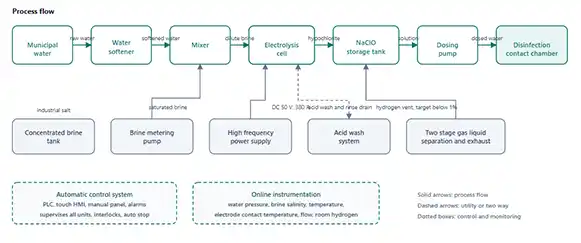
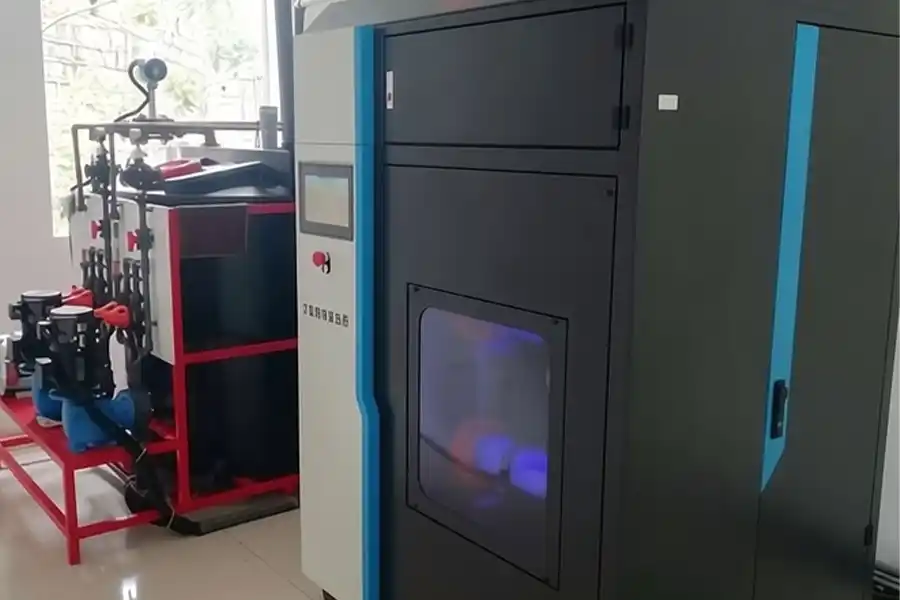
The QX-CL-2000-NaCLO is built as a skid mounted, prewired package. The diagram below shows how raw water, salt and power enter the system and how the finished disinfectant reaches the point of application.
Softening and brine preparation
The softening unit uses a dual tank, dual valve softener with CT100 ion exchange resin. It removes hardness from the process water so the brine entering the electrolytic cell stays soft and scaling is minimized. The softener regenerates automatically.
Salt is loaded into a 1000 L food grade PE dissolving tank. Softened water enters through a distribution header and dissolves the salt bed in the first pass. A circulation pump (60 L/h, 0.5 MPa, 0.37 kW) then recirculates the liquor through the distributor until the solution reaches saturation, without mechanical stirring. The saturated brine is metered into the dilution line, where it is mixed with softened water to the working concentration of 3.0% to 5.0%.
Generator main unit
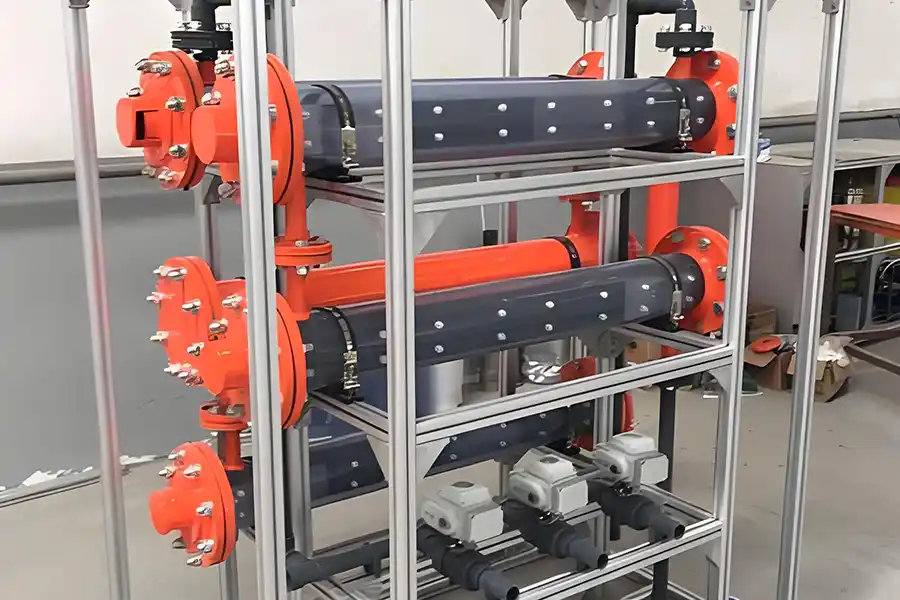
The main unit houses the electrolytic cell, the rectifier power supply, the PLC based control centre, flow and temperature switches, salinity monitoring, a touch screen, a manual panel, and hazardous gas sensors.
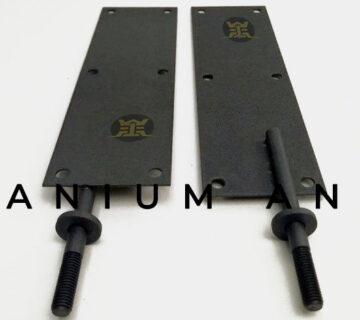
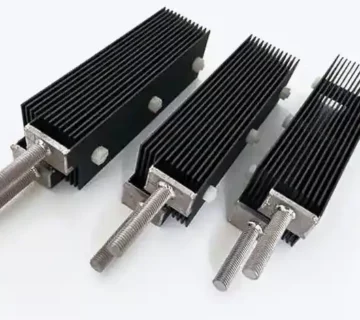
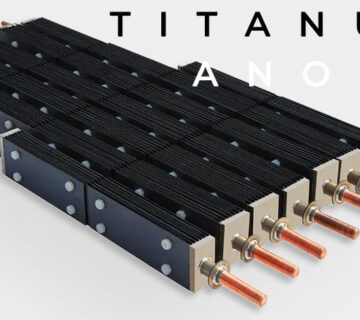
The cell is a tubular UPVC reactor with PVDF separators between the plate electrodes. The housing is corrosion resistant and dimensionally stable. The plate electrodes are made of Grade 1 titanium (ASTM B265). Because the anode is consumed during electrolysis while the cathode is protected, the anode surface carries a dense coating of ruthenium and iridium oxides, applied with 20 nm particles in 25 or more layers to a thickness of 20 µm. The coating keeps the overvoltage low and gives the electrode a long, stable service life.
The high frequency, switch mode constant current constant voltage power supply converts AC to DC at more than 95% efficiency. It provides protection against input overvoltage, undervoltage and phase loss, output overvoltage, overcurrent and short circuit, and internal overheat. The power stage is sealed against corrosion, moisture and dust.
Storage tank and hydrogen removal
Electrolysis releases a small amount of hydrogen. Hydrogen is flammable, so the system keeps its concentration far below the flammability limit. International practice, as reflected in IEC 60079-10-1 and NFPA 2, is to keep the concentration below 25% of the lower flammability limit. For hydrogen, 25% of 4% by volume equals 1% by volume. The system is therefore designed to hold hydrogen below 1%, with an exhaust that works continuously.
The cell outlet stream passes through two stages of gas liquid separation. The first stage removes most of the hydrogen before the liquid enters the 50 L food grade PE storage tank, and the second stage removes the remainder. A 220 V AC, 200 W, 55 m³/h forced draft fan blows air through the tank headspace so residual hydrogen is diluted and discharged through the vent pipe. The tank carries high, medium and low level switches. When the tank is full the generator pauses; when the level falls back to the refill point the generator restarts.
Automatic dosing
The dosing package consists of a corrosion resistant diaphragm metering pump (30 L/h, 0.7 MPa, 0.37 kW) and a variable frequency drive. The drive receives the plant flow signal and the control centre closes the loop, so the hypochlorite dose follows the water flow automatically. The solution can be added before or after filtration, provided the mixing time is at least 30 minutes.
Online instrumentation
Every safety critical variable is measured and alarmed: process water pressure, dilute brine salinity, electrolyte temperature, electrode contact temperature, brine flow, and hydrogen concentration in the generator room. Each instrument provides an alarm output, and the control centre stops the generator if any value leaves its safe window.
Acid cleaning
Softened water still contains trace ions, so scale slowly builds up on the electrodes. The first signs are a fast rise in electrolyte temperature and a drop in current efficiency. When this happens, the system switches the relevant valves and fills the cell with dilute hydrochloric acid from the acid cleaning tank. The cell soaks for 30 minutes to dissolve the scale, then clean water flushes it. The acid tank is a 50 L food grade PE vessel.
6.Electrode Technology and Service Life
The electrode assembly is the heart of the generator and the main factor in operating cost. The serial electrode arrangement (patent ZL 201120488431.9) keeps both salt consumption and DC power consumption low. The anode coating is guaranteed for one year, and the assembly is designed for a normal service life of 10 to 15 years. The coating itself is rated for continuous service above 5 years, and electrodes can be recoated and returned to service. The design holds DC power consumption below 4.0 kWh per kilogram of chlorine.
7.Site Requirements and Installation
Utility requirements
- Water supply at or above 0.3 MPa pressure and 5 m³/h flow.
- Power supply of 380 V AC, 50 Hz, with a connected load of 100 kW per set.
- Dosing point arranged as pre chlorination or post chlorination, with a mixing time of at least 30 minutes.
- Well ventilated, dry equipment room with lightning protection and a drainage trench.
Installation requirements
- The generator is installed indoors in an above ground room that is open to ventilation, with at least one wall directly exposed to the outside, no direct sunlight, and an ambient temperature above 10 °C.
- Because sodium hypochlorite is a strong oxidizer, the generator must not share a room with other electrical equipment. A separate equipment room is required.
- The control cabinet is installed in its own room, separate from equipment and raw materials.
- Equipment and raw materials are stored in a dedicated chemical storage room on a concrete foundation.
- The equipment room floor is concrete, with a washdown water supply and a floor drain connected to the drainage trench.
- An axial fan is mounted high on the wall to keep the room well ventilated.
- The room provides adequate lighting and a power supply sized for the connected load.
- Strict electrical and fire safety rules apply inside the equipment room.
8.Frequently Asked Questions
What does 2 kg/h mean on an electrolytic sodium hypochlorite generator?
It means the generator produces 2000 g of available chlorine per hour, equivalent to a continuous output of a 6000 to 8000 ppm sodium hypochlorite solution at the rated brine flow. The model QX-CL-2000-NaCLO is sized for this output per main unit.
How does brine electrolysis produce disinfectant?
A direct current is passed through dilute brine in an electrolytic cell. Chloride ions are oxidized at the anode to chlorine, which reacts with water to form hypochlorous acid and hypochlorite ions. The resulting solution is a strong oxidant that inactivates bacteria, viruses and algae.
Is sodium hypochlorite generation safer than chlorine gas?
Yes. The disinfectant is made on site from salt, water and electricity, so there is no chlorine gas transport, storage or cylinder handling, and the stored solution volume is small and short lived.
Which standards does this generator follow?
The design applies international equivalents of the original Chinese standards, including ISO 9001:2015, NSF/ANSI 60 and 61, the WHO Guidelines for Drinking Water Quality, EN 752:2017, IEC 61010-1, ISO 6107, IEC 60079-10-1 and NFPA 2. See the standards table in this guide.
Why is hydrogen removal important?
Electrolysis forms a small amount of hydrogen, which is flammable. The system separates hydrogen in two stages and dilutes it with forced air, keeping the room concentration below 1% by volume, well under the 4% lower flammability limit.
How often do the electrodes need cleaning?
Cleaning is on condition. When the electrolyte temperature rises quickly or the current efficiency drops, scale has built up. The system then runs an automatic acid wash with dilute hydrochloric acid: a 30 minute soak followed by a fresh water flush.
How long do the electrodes last?
The electrode assembly is guaranteed for one year and designed for a normal service life of 10 to 15 years. The anode coating is rated for more than 5 years of continuous service, and the electrodes can be recoated.
What site conditions are required?
You need a water supply at or above 0.3 MPa and 5 m³/h, 380 V AC 50 Hz power, a ventilated indoor room above 10 °C, a separate room for the generator and control cabinet, a chemical storage room with a concrete foundation, a concrete floor with a drain, and an exhaust fan.
A 2 kg/h electrolytic sodium hypochlorite generator converts three simple inputs, salt, softened water and electricity, into a reliable disinfectant at the point of use. The QX-CL-2000-NaCLO packages softening, brine preparation, electrolysis, storage, dosing and safety instrumentation into one automatic system. It produces 2000 g of chlorine per hour at a DC power consumption below 4 kWh per kilogram, keeps hydrogen below 1% by volume, and runs unattended for 24 hours a day.
For project specific engineering, dosing point selection and local compliance review, contact the manufacturer with your water quality report and plant flow data.
NEED AN ANODE ENGINEERED FOR YOUR SODIUM HYPOCHLORITE GENERATOR?
Send us your electrolyte composition, operating waveform, current density, cell geometry, and target service life. We provide quotation based on your drawings within 12 hours, and confirm a custom coating matched to your operating conditions within two business days.