
Coating, current density, and the cell life you actually get
A titanium anode in a wastewater cell does one of three jobs. It makes chlorine to disinfect, it oxidizes the COD that biology cannot reach, or it drives a reduction at the cathode. The coating follows from that job. The current density you choose decides how long the coating lasts.
The short answer
- Chloride above roughly 100 mg/L: Ru-Ir coating. Chlorine evolution is the reaction you want, and it is the cheapest one to drive.
- Chloride below 100 mg/L: Ir-Ta coating. Oxygen evolution takes the current, and RuO₂ will not survive it for long.
- Refractory COD, no chloride: lead dioxide on titanium holds the highest oxygen overpotential, with a lead leaching check on the discharge.
- Design current density usually lands between 100 and 1,000 A/m². Every step up that range saves electrode area you would otherwise buy in titanium, and costs coating life.
Most of the questions we answer about wastewater anodes are not about oxide chemistry. They are about a plant that bought the right coating and still changed the electrodes twice in three years. The gap between those two outcomes is usually a number: the current density the cell actually runs at, against the one the anode was specified for.
What the anode is actually being asked to do
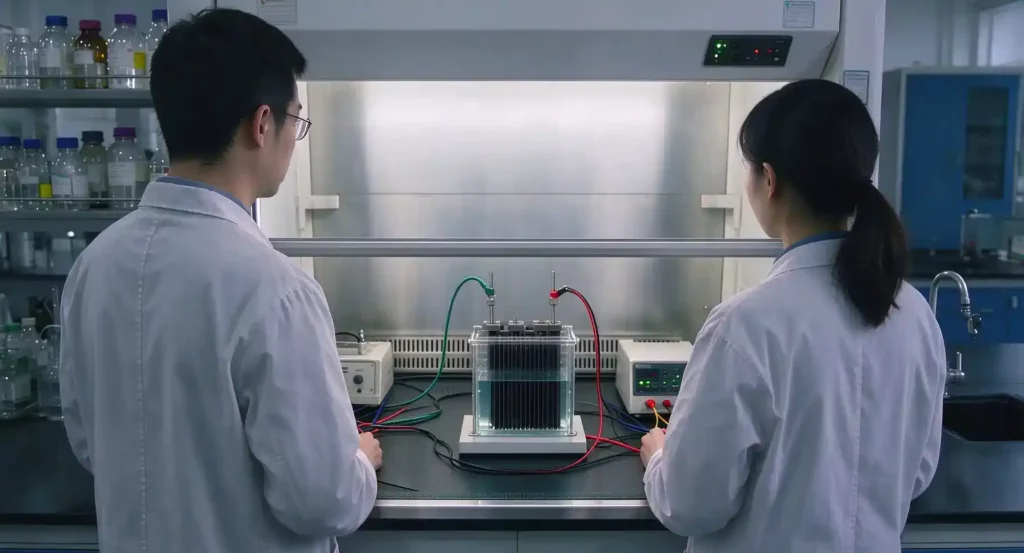
In a biological plant the bacteria do the work. In an electrochemical cell the anode surface is the reactor, and three mechanisms share the current. Most real systems run two of them at once.
Direct anodic oxidation
Organics that reach the coating exchange electrons with it directly. This works on phenols, dyes and some pharmaceuticals, but only when the molecule gets to the surface before something else oxidizes first. Mass transfer, not kinetics, usually sets the rate.
Indirect oxidation through hydroxyl radicals
At a high oxygen overpotential the coating generates adsorbed hydroxyl radicals (·OH) that attack the aromatic ring and break it open. This is why lead dioxide and doped tin oxide keep showing up in the literature on landfill leachate and textile effluent. They hold a high overpotential for oxygen, so more of the charge goes into making radicals instead of bubbles.
Mediated oxidation through active chlorine
In any stream carrying chloride, the anode makes Cl₂, which hydrolyzes to hypochlorous acid and hypochlorite (ClO⁻). You get disinfection and ammonia oxidation in the same pass. At 100% current efficiency, one amp-hour liberates about 1.32 g of Cl₂. That figure is worth remembering, because it turns a vague “we need more power” conversation into a chlorine balance you can check. Published bench-scale work on a RuO₂–IrO₂/Ti electrode reported about 92% removal of 125 mg/L phenol in 180 minutes at 38 mA/cm² with 0.25 M NaCl at pH 10, with indirect oxidation by hypochlorite and superoxide radicals dominating the degradation route.
Electrocoagulation and hybrid cells
Conventional electrocoagulation often uses iron or aluminum plates that dissolve to release metal ions, which form flocs that capture suspended solids, oil, and emulsions. DSA titanium anodes do not work that way — they are inert. In hybrid treatment systems, a titanium anode handles the oxidative and disinfection half-reaction, while a separate sacrificial stage, settling step, or paired cathode does coagulation and metal removal. Mixing the two roles in one electrode usually means compromising one of them.
Which mechanism dominates is set by the water, not by the rectifier. The same electrode in a saline effluent behaves nothing like it does in a low-chloride municipal stream, even at identical amperage.
If you size the cell on COD alone and the stream carries chloride, you are buying two processes and paying for one. If you size it on chloride and the chloride is seasonal, you are buying an anode that spends part of the year in oxygen duty. Both mistakes are common, and both are visible in the water analysis before anything is built.
Where titanium anodes are used in wastewater treatment
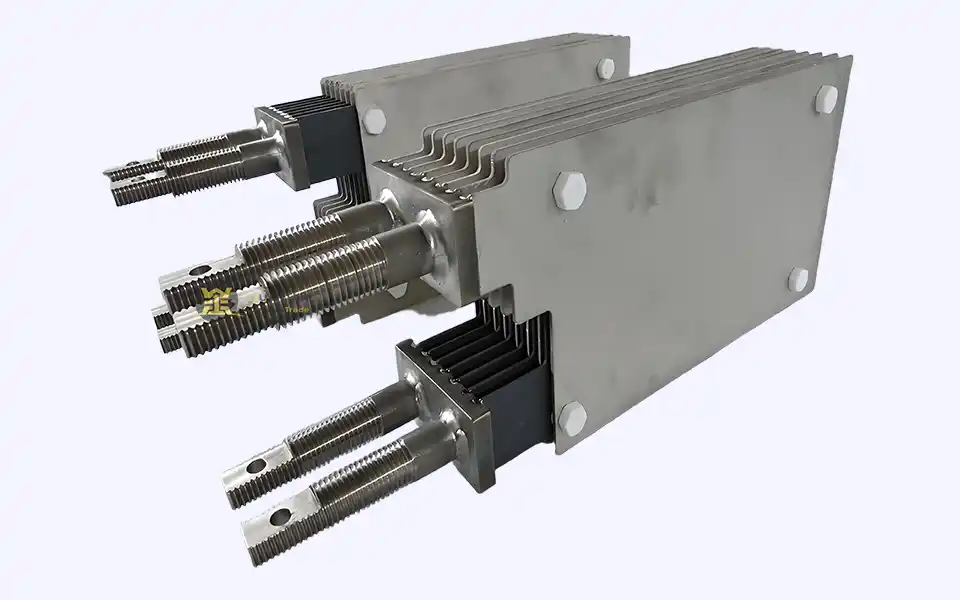
These are the duties our wastewater work most often lands in. The same MMO titanium substrate appears across nine duty classes, from cathodic protection at 10 A/m² to PEM stacks at 20,000 A/m²; the coating and geometry change with the stream.
Color and COD removal
Ru-Ir anodes break azo-dye fragments and decolorize effluent that carries residual chloride from dyeing and rinsing stages, cutting color load before biological polishing or discharge.
Phenolic and emulsified oil wastewater
Indirect oxidation and radical pathways target phenols, solvents, and persistent organics; cells are usually paired with degreasing or flotation to keep oil films off the electrode surface.
Ammonia-bearing effluent
Active-chlorine oxidation drives breakpoint removal of ammonia and partial nitrogen in refinery, fertilizer, coking, and landfill-leachate streams, with chloride dosed where the raw water lacks it.
Cyanide and heavy-metal effluent
Anodic oxidation treats cyanide-bearing rinse water; cathodic deposition supports metal recovery. Ir-Ta coatings are often evaluated for acidic, low-chloride circuits.
Water reuse and ballast water
On-site hypochlorite polishing controls pathogens and biofouling in recycled water, cooling-tower side streams, and vessel ballast systems without transporting bulk chlorine.
Hypochlorite generator anode sets
Many rebuilds are existing electrolytic sodium hypochlorite generators whose electrode sets need replacement in the original tank and bus configuration.
Coating choice starts with chloride, not with the pollutant
Buyers usually send the pollutant list first. The useful first question is chloride, because chloride decides which anodic reaction wins the current. Above roughly 100 mg/L, Ru-Ir coated titanium anodes are usually the right call: RuO₂ has the lowest chlorine overpotential of the common MMO families, and disinfection comes along for free. Below that line, oxygen evolution takes the current, and Ir-Ta (IrO₂–Ta₂O₅) is the stable choice.
| Coating | Reaction it favors | Where it fits | Design current density | Typical end of life |
|---|---|---|---|---|
| RuO₂–IrO₂ | Chlorine evolution | Saline effluent, disinfection, ammonia and cyanide oxidation | 100–1,500 A/m² | Passivation under oxygen when chloride drops |
| IrO₂–Ta₂O₅ | Oxygen evolution | Low-chloride effluent, dye and pharmaceutical COD, acid service | 100–1,000 A/m² | Gradual coating thinning at high current |
| IrO₂–SnO₂ | Mixed, radical-leaning | Leachate and mixed industrial effluent at moderate cost | 100–600 A/m² | Thinning, occasional mud-cracking |
| PbO₂ on Ti | Oxygen, high overpotential | Refractory COD with no chloride, complete mineralization targets | 100–500 A/m² | Spall at edges, lead leaching risk |
| Pt on Ti | Mixed | Niche and small cells, some disinfection duty | 100–1,000 A/m² | Platinum dissolution at high current |
The 100 mg/L line is a rule of thumb, not a specification. Seasonal chloride swings, ammonia, silica, temperature and current density all move the answer. If your chloride crosses that line through the year, specify against the worst case, or ask for a hybrid loading that trades some chlorine activity for oxygen stability. The reasoning behind each family is set out in our RuO₂ electrode guide and the Ir-Ta anode guide.
Platinized titanium is the family buyers ask about most often and need least often. Platinum is a good catalyst, but in chloride service it dissolves, and in wastewater duty you rarely need what it costs. If you are comparing it against MMO for a water application, read the platinized anode notes before the quote stage.
Current density: the number you actually control
Coating is consumed in proportion to the charge that passes through each square meter of it. That single sentence explains most of the arguments about electrode life. You cannot change how much charge the treatment target needs. You can change how much area you spread it over.
A worked example. A cell needs 1,800 A. At 300 A/m² that is 6 m² of anode. At 150 A/m² it is 12 m². The second cell costs more titanium, more tank volume and more floor space. In exchange, each square meter carries half the charge, so the coating should last roughly twice as long, and the cell runs cooler with less scale forming on the surface.
Coating selector
Three inputs, one starting point. Move the sliders to match your water analysis.
Schematic guidance from our own design rules, not a warranty. Fluoride, ammonia, silica, temperature and cell hydraulics all move the answer. Send the analysis and we will run it properly.
Life does not stay inverse to current density for long. Above the design window, the coating heats, the oxygen overpotential rises, and wear accelerates faster than the charge math predicts. Lean chloride makes it worse: the same amperage in softer water pushes more current into oxygen evolution, which is the reaction that consumes Ir and Ru fastest. Continuous feed temperature should stay below about 60°C; a tank that starts at 25°C does not stay there, because the cell heats itself.
Anodes rarely come back because the oxide chemistry was wrong. They come back because the cell drifted: current density crept up as the plant pushed flow, the anode sat cathodic during a shutdown, or someone chipped scale off with a wire brush. The installation and maintenance procedure covers the shutdown and cleaning rules that prevent most of it.
The substrate and why titanium beats graphite and lead
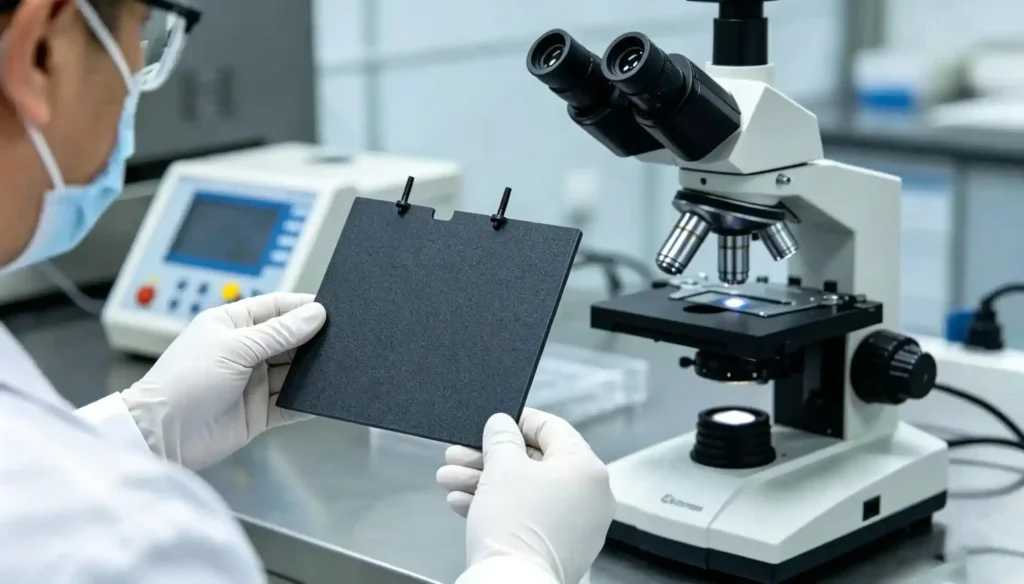
Grade 1 or Grade 2 per ASTM B265 covers almost everything in water treatment. Grade 1 is softer and easier to form. Grade 2 carries a little more strength and is the usual pick for plate anodes that have to stay flat across a wide gap. Both rely on the same passive oxide film for corrosion resistance, and that film is exactly why a coating has to be there: it protects the metal and blocks the current at the same time.
Wall thickness is a current-carrying decision as much as a stiffness decision. Thin plate flexes, the gap closes at one end of the cell, and that end runs hot. The connection deserves more attention than most drawings give it. A dry joint or an undersized tab becomes a resistance hotspot, and a hotspot ends an anode long before the coating is spent.
| Attribute | MMO titanium anode (DSA) | Graphite | Lead alloy |
|---|---|---|---|
| Dimensional stability | Stable over service life; gap and voltage hold steady | Erodes over time; spacing widens, voltage climbs | Softens and corrodes; shape changes in service |
| Corrosion resistance | High across a wide pH and chloride range | Moderate; sensitive to abrasion and oxidation | Poor in many acidic and organic streams |
| Catalytic activity | Tailored coating for chlorine or oxygen evolution | Low and fixed; high overpotential | Variable, depends on alloy and passivation |
| Energy consumption | Lower overpotential; steadier cell voltage | Higher resistive and overpotential losses | Variable; passivation raises voltage |
| Product / sludge contamination | No anode material released | Carbon fines in sludge | Leaching and sludge-disposal concerns |
| Maintenance | Clean in place; coating can be stripped and recoated | Discard and replace as it wears | Replacement; waste handling regulated in many regions |
The honest tradeoff is upfront cost. A DSA titanium electrode costs more per piece than graphite, and the payback comes from lower kWh per cubic meter, longer intervals between changes, and avoiding contaminated sludge disposal. On high-throughput or continuous-duty treatment, that payback usually shows up within the first operating year. If you want the full build sequence, from substrate machining through coating application and baking, the primer on coated titanium anodes covers it.
Five things in the water that end an anode early
Coating selection gets the attention. Water chemistry ends the argument. These five come up again and again in failure reports.
- Fluoride. Above about 1 to 2 mg/L in acidic water, fluoride attacks the titanium substrate through pinholes in the coating. This is a substrate failure, not a coating failure, and no increase in loading fixes it. If your feed carries fluoride, treat it upstream or accept a shorter life.
- Ammonia. Ammonia consumes chlorine as fast as the anode makes it. A high-ammonia loop looks like a dead electrode when it is really a chlorine demand problem. Size on the residual you need, not on the amperage on the nameplate.
- Hardness and silica. Scale blinds the coating. Voltage climbs at constant current, the cell heats, and coating life falls with it. Descale on evidence, meaning a voltage rise that reverses after rinsing, not on a fixed calendar.
- Temperature. Kinetics improve and coating consumption rises at the same time. Keep the cell below the temperature you specified for, and remember that the cell heats itself.
- Reverse polarity. A shutdown that leaves the anode cathodic, or a rectifier wired backwards after maintenance, hydrides the titanium and blisters the coating within hours. Interlocks cost less than electrodes.
Two more are worth a mention because they are easy to miss. Sulfite and other reducing agents scavenge the oxidant you just made, so a dechlorination step upstream of the cell quietly doubles the power bill. And oil or grease coats the surface, which is a fouling problem that looks exactly like a coating failure on the voltage trend.
What to put on the drawing and the purchase order
A wastewater anode quote is only as good as the document behind it. These are the eight lines that decide whether the electrode you receive can do the job you sized it for.
| Item | What to state | Why it changes the outcome |
|---|---|---|
| Substrate | ASTM B265 Grade 1 or 2, thickness with tolerance | Sets stiffness across the gap and current-carrying section |
| Active area | Coated dimensions in mm, tolerance on the coated face | A 5% area shortfall is a 5% rise in current density |
| Coating family | Ru-Ir, Ir-Ta, Ir-Sn, PbO₂ or Pt | Decides which reaction wins the current |
| Loading | g/m² of noble metal, typically 8 to 25 | Sets life at a given current density |
| Design basis | Current density in A/m² plus the water analysis behind it | Makes the life claim auditable |
| Life test | Test condition, electrolyte and pass criterion | Turns a number into a testable statement |
| Connection | Tab, bus, threaded stud or weld, with the mating material | Most mechanical failures start here |
| Water analysis | Attached, including chloride, fluoride, ammonia, silica, hardness, TOC, pH | Coating selection cannot be reviewed without it |
If you only tighten one line, tighten the design basis. A supplier who knows the current density and the water can defend a life figure. A supplier who knows neither will quote the loading that is easiest to make.
Acceptance testing without waiting two years
Nobody runs a two-year field trial before a first order. What you can do is make the supplier’s claim checkable before the electrode ships.
An accelerated life test at high current density compresses years into weeks. We run ours at 20,000 A/m² on every batch, which is hard on the coating and useful for ranking formulations. The absolute hours are not a service life. Ask for the test condition, the electrolyte, the endpoint definition, and which production batch the coupon came from.
Three checks belong next to it. Coating loading by XRF on a coupon from the same run, because loading in g/m² is measurable and it is the number that sets life. An adhesion check, either a bend test or a thermal shock, because a coating that lifts at the edge fails early regardless of chemistry. And a dimensional report on the coated area, because that is what you paid for.
“What current density does your life figure assume?” If the answer is vague, the figure is marketing. If the answer is a number and an electrolyte, you can compare it against your own duty and decide whether the quote is realistic.
Compare cost per year of service, not price per square meter
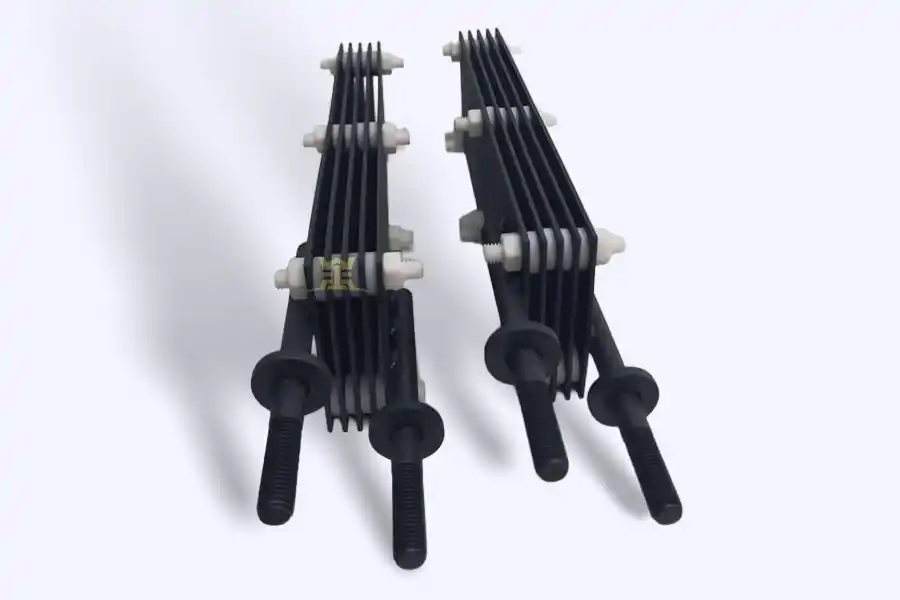
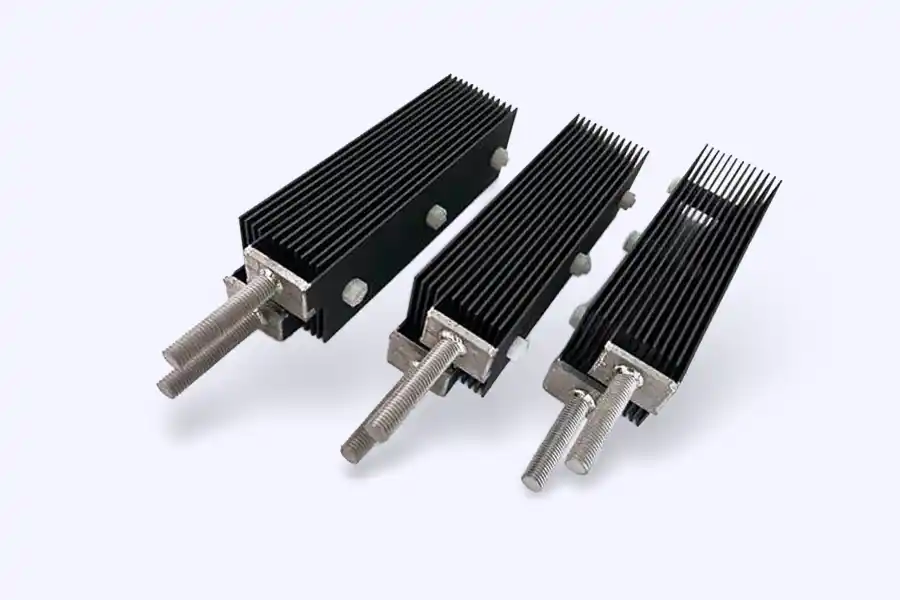
Two quotes for the same tank often differ by 30% on price and by more than that on life, because the two suppliers assumed different current densities. Put both on the same basis: price per square meter divided by expected years at your actual current density, not theirs.
A cheaper anode run at 400 A/m² can lose to a dearer one run at 200 A/m² with twice the area. It loses quietly, two winters later, when the replacement is a purchase nobody budgeted for and the downtime lands in the middle of a discharge consent period.
Recoating changes the math in your favor. If the substrate is sound and the failure was coating wear rather than hydriding or mechanical damage, the titanium can be stripped and recoated. That usually costs less than a new electrode and keeps the dimensions the cell was built around. Our service scope covers the assessment that decides whether recoating is safe.
Questions we get from plant engineers
What coating should I use for wastewater with low chloride?
Ir-Ta, meaning IrO₂–Ta₂O₅. Below about 100 mg/L chloride, oxygen evolution carries most of the current, and Ir-Ta is far more stable under oxygen than Ru-Ir. If chloride swings above that line through the year, specify against the highest value you expect or ask for a hybrid loading.
Which coating works for dye and textile effluent?
A ruthenium-iridium (RuO₂–IrO₂) coating is the usual starting point when chloride is present, because it favors chlorine and active-chlorine evolution used in decolorization. For acidic, low-chloride streams, evaluate an iridium-tantalum (IrO₂–Ta₂O₅) coating instead. A bench or pilot run on your actual effluent removes most of the guesswork.
Can titanium anodes treat wastewater without added salt?
Yes, but performance depends on conductivity. Without chloride, the cell relies more on direct anodic oxidation and radical pathways, and Ir-Ta coatings are often a better fit. Adding NaCl raises current and active-chlorine oxidation, but it changes residuals and water chemistry, so it should be planned into the process rather than added after commissioning.
How long does a titanium anode last in wastewater service?
Most MMO titanium anodes run 1 to 3 years under normal continuous duty at rated current density; clean-brine disinfection cells can last longer. Life drops sharply under over-current, high temperature, pH extremes, or fouling. Per-lot accelerated life tests help compare coating systems before you commit to a purchase order.
Are titanium anodes consumed like aluminum or iron electrocoagulation plates?
No. The titanium substrate and MMO coating are inert and do not sacrifice themselves. Iron or aluminum plates dissolve to form flocs; titanium anodes stay dimensionally stable and are usually paired with a separate coagulation, settling, or filtration stage.
Can a titanium anode be recoated instead of replaced?
Usually yes. If the substrate has not been hydrided and the failure is coating wear, the old oxide is stripped and a new coating applied. Recoating keeps the original dimensions, which matters when the cell gap and the bus were built around them.
Why did my anode fail in 14 months when the quote said five years?
The usual causes are current density above the design basis, fluoride in the feed, the anode going cathodic during shutdowns, or scale removed with a wire brush. Ask for a failure analysis before reordering, or the replacement will fail the same way.
Do I need a separate hypochlorite generator?
Only if disinfection is the main job and the stream carries little chloride. Where the effluent is already saline, an in-cell anode can make active chlorine in the same pass that oxidizes COD. Dedicated generator sets make sense when you need a stored, doseable product.
Can an old graphite or lead-alloy cell be converted to titanium anodes?
Often yes, but the rectifier rating, electrode spacing, cathode material, and busbar connections must be rechecked. Titanium anodes draw current differently and hold a steadier voltage than eroding graphite, so the power supply and cell hydraulics should be reviewed before ordering replacement electrodes.
What water data is needed to quote a wastewater anode?
Provide pH, conductivity or TDS, chloride and sulfate levels, fluoride, ammonia, hardness and silica, target contaminants with inlet and outlet concentrations, flow rate, temperature, duty cycle, and existing cell dimensions. This lets the supplier match coating, geometry, and coating load to the duty. More answers are in the site FAQ.
How do I know the loading I was quoted?
Ask for an XRF loading report from the production batch, not a certificate of compliance. Loading in g/m² is measurable on a coupon from the same run, and it is the number that sets life at your current density.
Send the water analysis first
Coating selection is a short decision once the numbers are on the table. What we need: chloride, COD or TOC, ammonia, hardness, silica, fluoride, conductivity, pH and temperature, plus flow rate and the discharge target. With those, we come back with a coating family, a loading, a current density and an electrode area, and you can check the arithmetic yourself.
Quanjin Industry & Trade manufactures MMO-coated titanium anodes in Baoji, China — commercially pure Gr1/Gr2 substrate, noble-metal oxide loading from 8 to 25 g/m², and an accelerated life test on each batch. MOQ starts at one piece, with typical delivery of 15 to 20 working days after drawing approval. The titanium anode cataloglists plate, mesh, tube, and rod configurations, and the complete electrode guidegoes deeper on substrate and coating specifications than this note does.