
Most titanium electrode failures are decided on the drawing, months before the cell is ever energized. This guide covers the five choices that set coating life, the arithmetic that sizes an anode, the tests worth paying for, and the six-year cost model that explains why the cheapest quote usually loses.
Key takeaways
- The coating does the electrochemistry. The titanium only holds it, carries current, and keeps its shape. Choose the coating by the reaction at the surface, not by price or by what the last supplier shipped.
- Grade 1 and Grade 2 both work as substrates. Grade 1 forms and welds more easily; Grade 2 is stronger and easier to source. Neither grade makes up for poor surface preparation.
- Current density is the biggest single lever on service life. Halving it typically multiplies coating life by three to five times; running 20 percent above the rating can cost you a third of it.
- Coating loading in g/m², layer count, and the accelerated life test result are the three numbers that separate an engineered quote from a price. Get all three in writing.
- Over six years the cheap anode usually costs more. Shorter life means more changeouts, and a higher overpotential quietly adds to the power bill every hour the cell runs.
Five decisions that decide everything
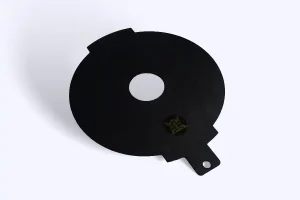
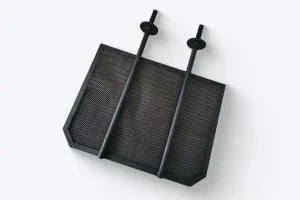
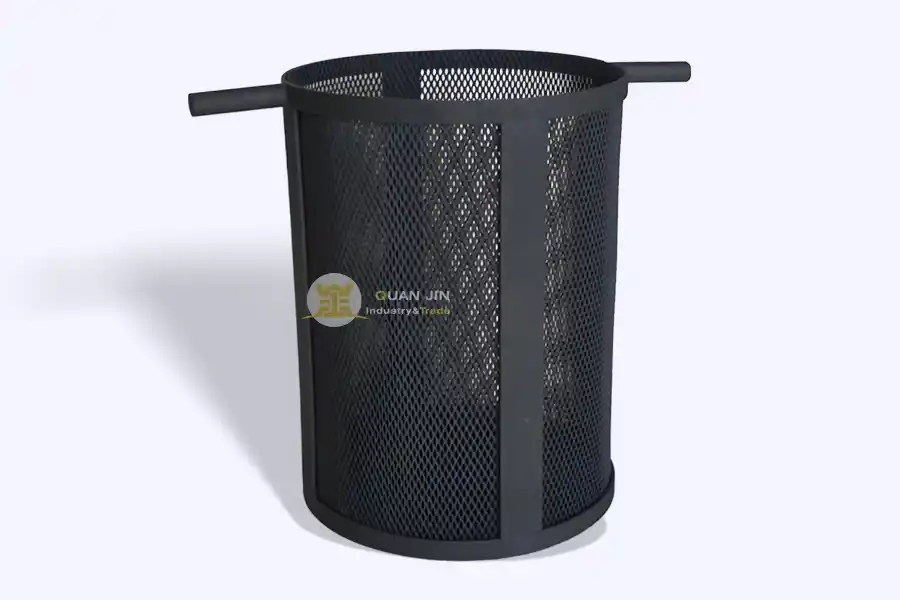
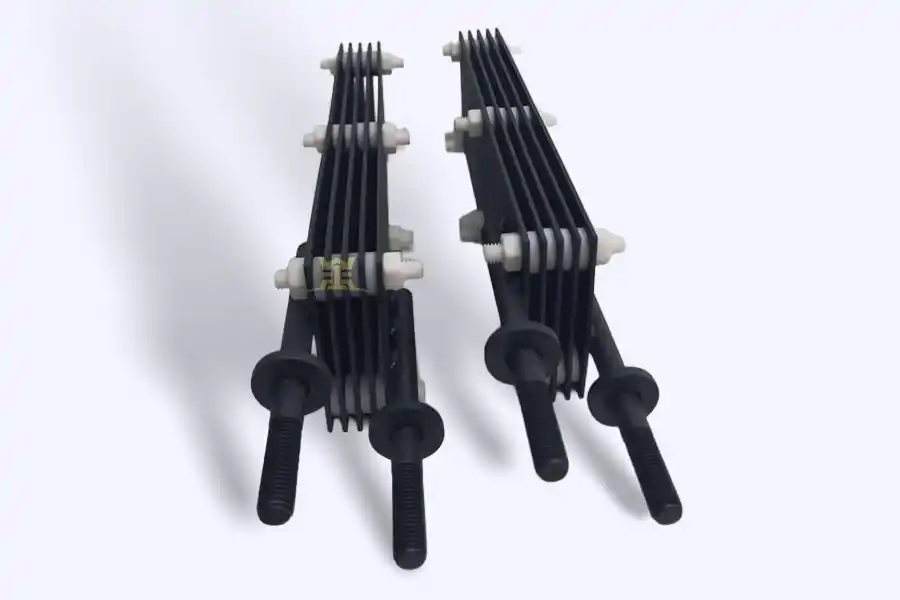
A coated titanium anode is a simple object: a plate, mesh, tube, or rod of commercially pure titanium with a ceramic skin a few microns thick. What makes it complicated is that almost every decision that matters is locked in at the quotation stage, long before anyone measures a cell voltage. Five of them carry most of the weight.
- The reaction at the surface. Chlorine evolution and oxygen evolution need different oxides. Get this wrong and no amount of extra coating loading will save the anode.
- Substrate grade and thickness. Grade 1 or Grade 2 to ASTM B265, sized for the mechanical load, the gap tolerance, and the way the part is formed.
- Surface preparation. Grit blasting plus an acid etch. This is the step that decides whether the coating is bonded or merely sitting on top.
- Coating chemistry and loading. Which oxides, in what ratio, at how many grams per square meter, applied in how many layers.
- Geometry and current density. Plate area, gap, gas release, and the amps per square meter the anode will actually see in your cell, not the number in the catalog.
These five are coupled. A well-loaded iridium coating still fails early if the plate runs at twice its rated density with a 3 mm gap and no gas escape. A perfect current density does nothing for a coating that was etched for twenty minutes instead of two hours. When a shipment fails in the field, the cause is usually traceable to one of the five, and the fix is usually in the specification rather than in the coating recipe.
One definition first. In plant language, “titanium electrode” almost always means the anode. Titanium can be a cathode too, but nobody coats a cathode with precious metal oxides, because the reactions that make the coating worthwhile only happen on the positive side. Everything below refers to the anode.
Substrate: Grade 1 or Grade 2, and how thick
The substrate is commercially pure titanium, and in practice it is one of two grades. Both are covered by ASTM B265, the standard specification for titanium strip, sheet, and plate. The differences that matter to an anode are small on paper and noticeable on the shop floor.
| Property | Grade 1 (UNS R50250) | Grade 2 (UNS R50400) |
|---|---|---|
| Titanium content | About 99.5 percent minimum | About 99.2 percent minimum |
| Oxygen, max | 0.18 percent | 0.25 percent |
| Tensile strength, typical | Around 240 MPa | Around 345 MPa |
| Formability | Best. Deep draws, tight bends, expanded mesh | Good. Fine for plates, tubes, rods |
| Where we use it | Expanded mesh, woven mesh, complex formed parts, thin foil | Plates, tube anodes, ribbon, busbar connections |
| Availability | Good, fewer stock sizes | Best of any grade |
Grade 1 is softer and easier to form, which is why mesh and thin-walled parts are usually made from it. Grade 2 has roughly 40 percent more tensile strength, holds a flat plate flatter after machining, and is the default for plate and tube anodes. Neither grade resists corrosion better than the other in a meaningful way for anode service: both rely on the same passive oxide film, and both are equally intolerant of fluoride.
Thickness and flatness are not cosmetic
Plate anodes usually run 1 to 3 mm thick. Mesh runs 0.5 to 2 mm, tube walls 1 to 2 mm, and flexible ribbon 0.5 to 1 mm thick by 6 to 13 mm wide. Under-sizing thickness to save titanium is a false economy: the plate has to survive handling, clamping, and years of gas agitation without bowing into the gap.
Flatness matters more than most buyers expect. On a 1 m² plate, a 2 mm bow changes the anode-to-cathode gap across the face, and the current follows the gap. The near side runs hot and the far side runs starved, so the coating wears unevenly and the voltage starts to creep up long before the average loading is used up. If your cell has a tight gap, specify flatness and check it on receipt with a straight edge, not with your hand.
Coating: pick the reaction, not the catalog
Every coating decision starts with one question: what comes off the surface, chlorine or oxygen? Ruthenium-based oxides are fast at chlorine evolution and mediocre at oxygen evolution. Iridium-based oxides are the reverse. The gap between them is not a marketing distinction; it shows up as hundreds of millivolts and as years of life.
The reason is chemical. Ruthenium dioxide is an excellent chlorine-evolution catalyst, but in an acid cell evolving oxygen it oxidizes further and dissolves. Iridium dioxide survives oxygen evolution far longer because it grows a stable, conductive oxide that does not keep dissolving. Put a ruthenium coating in an oxygen-evolution duty and you will see the voltage climb within months. Put an iridium coating in a brine cell and you have paid for stability you did not need while giving up some chlorine activity.
The four families in practice
| Coating | Reaction | Loading | Current density | Typical life | Watch out for |
|---|---|---|---|---|---|
| Ru-Ir-Ti oxide (MMO) | Chlorine | 8 to 20 g/m² | 1,000 to 3,000 A/m² | 5 to 10 years in hypochlorite | Oxygen-evolution duty, dry-out, reverse polarity |
| Ir-Ta oxide (MMO) | Oxygen | 15 to 25 g/m² | 500 to 3,000 A/m²; 7,000 to 10,000 A/m² for copper foil | 2 to 5 years plating; 8 to 12 months foil | Fluoride above 1 ppm, organic contamination, high chloride with oxygen duty |
| Platinum | Both, with high stability | 1 to 5 µm plated; 25 to 125 µm clad | Up to about 1,000 A/m² | 1 to 5 years | Baths that dissolve platinum, high-current chloride service, mechanical wear |
| Lead dioxide on Ti | Oxygen at high potential | Thick film, mm scale | 200 to 2,000 A/m² | 1 to 4 years | Lead contamination of product, low pH with high chloride, brittle layer |
Two of these need a word of warning. Platinized titanium is the right answer when the bath cannot tolerate a metal that dissolves, such as precious-metal plating, but platinum is a thin metal film, not a ceramic, and it wears mechanically as well as electrochemically. Lead dioxide is the specialist for high-potential oxidation of refractory organics; it works, but lead slip into the product stream rules it out for anything touching food, drinking water, or pharmaceutical product.
Loading, current density, and what “life” really means
Coating loading is the mass of precious metal per square meter of coated surface, usually quoted as grams per square meter with both faces counted separately. It is the closest thing the industry has to a fuel gauge. A 10 g/m² coating has roughly half the active material of a 20 g/m² coating, and at the same current density it will generally last about half as long.
That relationship holds until it does not. Past a certain loading, extra oxide adds thickness faster than it adds life, and the coating becomes more prone to mud-cracking and spalling during thermal cycling. For most industrial anodes the useful band is 8 to 25 g/m². Above that, you are usually better off buying more anode area than more coating.
Why current density dominates
Current density is amps divided by active area. It sets how fast the coating is consumed, how much gas is generated per square centimeter, and how hard the coating has to work to keep overpotential down. The relationship is not linear. As a working approximation, coating life scales with current density to the power of about -1.7:
So an anode rated for five years at 1,500 A/m² gives you roughly three years at 2,000 A/m², because (1,500 / 2,000)^1.7 ≈ 0.61. Drop to 1,000 A/m² and the same anode stretches toward nine years. This is why a modest increase in anode area so often pays for itself, and why “we’ll just push the current a bit” is the most expensive sentence in the plant.
Temperature works the same way, just less predictably. As a rule of thumb, coating consumption roughly doubles for every 10 to 15 °C above the rating, and the effect compounds with current density. A cell running at 65 °C instead of 55 °C is not 18 percent harder on the anode; in coating terms it can be twice as hard.
Reading an accelerated life test
Nobody wants to wait five years to find out whether a coating is good, so the industry compresses the test. A coupon is run at very high current density in 1 M sulfuric acid at 40 °C, typically at 40 kA/m², and the time until the cell voltage jumps is recorded. The jump marks the moment the coating is spent and the titanium starts to passivate.
Two things about that number. First, it is a ranking tool, not a calendar. Forty hours in the acid test does not mean forty weeks in your brine cell. It tells you how one coating compares with another, and whether a production batch matches the sample you approved. Second, it is sensitive to how the test is run: acid concentration, temperature control, and coupon geometry all move the result. When you compare two suppliers’ ALT numbers, make sure they used the same conditions, or the comparison is meaningless.
What to ask for: the test conditions, the batch number, and the raw hours rather than a pass stamp. Many buyers specify a 40-hour floor at 40 kA/m² for standard duty and 100 hours or more for heavy-duty coatings. Those are reasonable thresholds, not universal ones.
Sizing an anode: the arithmetic, then the judgment
The arithmetic is one division. Active area equals cell current divided by the current density you have chosen: A = I / J
Take a 5,000 A hypochlorite cell at 1,500 A/m². That needs 3.33 m² of active surface. A 500 × 500 mm plate coated on both faces gives 0.5 m², so you need 6.7 plates, which means 7 plates, which puts the real current density at 1,429 A/m². The plate count is always rounded up, and the rounded number is the one that goes on the drawing and into the life calculation.
Then the judgment starts, because three things push the answer around.
- Gas blanketing. In chlorine and hypochlorite cells, gas bubbles cling to the coating and blank off part of the surface. The effective area is smaller than the geometric area, so experienced designers add 10 to 20 percent area rather than run the coating at its nameplate limit.
- Edge and contact zones. The strip under the busbar and the first few millimeters of edge do not carry useful current. Count only the wetted, coated area, and mask the contact zone so it stays clean.
- Gap and alignment. A 10 mm gap with a 2 mm bow is a 20 percent variation in local resistance. If the cell is tight, spend the money on flatness before you spend it on loading.
Anode area calculator
Enter the duty and a plate size. The calculator returns the active area, the plate count after rounding up, and the current density you will actually run. The default 10 percent headroom is the gas-blanketing allowance described above; set it to zero to reproduce the plain division.
What a millivolt costs
Anode overpotential is the voltage you pay to make the reaction happen at the rate you want. A good chlorine-evolution coating runs at roughly 50 to 100 mV above the thermodynamic value; a tired or badly matched coating can sit 200 to 300 mV higher. That difference does not appear on the anode invoice. It appears on the electricity bill, every hour, for years.
The math is simple enough to do on a quote sheet. Power equals current times the voltage penalty. On a 5,000 A cell, an extra 45 mV is 225 W. Run 7,500 hours a year and that is 1,688 kWh, or about $152 a year at $0.09/kWh. Over a six-year window it comes to roughly $900, which is often the entire gap between a budget anode and a properly loaded one.
| Assumption | Value | Note |
|---|---|---|
| Cell current | 5,000 A | Hypochlorite duty, 4.0 V cell voltage |
| Operating hours | 7,500 h/year | About 85 percent availability |
| Electricity | $0.09/kWh | Industrial rate, excluding demand charges |
| Evaluation window | 6 years | One coating cycle for the mid-case anode |
| Excluded | Labor, downtime, disposal | Each favors the longer-life option, so the comparison is conservative |
| Option | Price | Expected life | Anode cost over 6 years | Energy penalty over 6 years | Total |
|---|---|---|---|---|---|
| A. Budget coating, 8 g/m², thin oxide | $1,800 | 3 years | $3,600 | $911 | $4,511 |
| B. Specified coating, 15 g/m² | $2,600 | 6 years | $2,600 | None | $2,600 |
| C. Option B plus 30 percent area | $3,400 | 9 to 10 years | $2,170 | None | $2,170 |
The ranking is not subtle. The budget anode costs the least at the purchase order and the most over six years, by a wide margin, because you buy it twice and you pay an energy penalty in between. Option C wins on total cost but asks for footprint you may not have. For most retrofits, Option B is the honest recommendation: pay for the loading and the coating match, keep the tank as it is.
One more line item that never makes it into these tables: downtime. A planned anode change is a few hours. An unplanned one, in the middle of a production run with a tank full of product, is a different number entirely, and it usually dwarfs the difference between quotes.
What to inspect before you pay
A coating you cannot measure is a coating you cannot manage. The list below is what we would want to see if we were buying anodes instead of making them, and it is roughly what a serious buyer asks us for.
| Check | Method | Typical acceptance |
|---|---|---|
| Substrate traceability | Mill certificate, EN 10204 3.1 | Heat number matches the parts; grade and thickness as ordered |
| Dimensions and flatness | Calipers, straight edge, template | Drawing tolerances; bow under 2 mm per meter on plate |
| Visual | Inspection under 500 lux, no magnification required | No bare spots, scratches through the coating, weld spatter, or handling marks |
| Coating loading | Weight gain on a witness coupon coated in the same batch | Declared g/m² within plus or minus 10 percent |
| Coating thickness | XRF at five or more points per face | 2 to 10 µm, uniform within 15 percent |
| Adhesion | 180° bend around a 12 mm mandrel | No peeling or flaking at the bend |
| Chlorine overpotential | 2,000 A/m² in saturated NaCl at 25 °C | 1.08 V or lower for Ru-Ir coatings |
| Polarization slope | 200 to 2,000 A/m², same electrolyte | 35 mV or less across the range |
| Accelerated life | 1 M H2SO4, 40 °C, 40 kA/m² | Agreed minimum, raw hours reported per batch |
| Contact and busbar | Resistance measurement at the joint | Recorded value, stable after torque |
| Packing | Visual, on opening | Coated faces protected, no plasticizer contact, desiccant present |
Two of these checks matter more than the rest. Loading, because it is the one number that predicts life and the one number a supplier can quietly shade. And adhesion, because a coating that passes every electrochemical test but lifts at a bend will fail in service at the clamp, where the mechanical stress actually is.
How they fail, and what the failure tells you
Coated titanium anodes fail in a small number of recognizable ways. The pattern of the voltage rise is usually enough to name the cause before anyone touches the cell.
| What you see | Most likely cause | What to check |
|---|---|---|
| Voltage climbs slowly over many months | Normal coating consumption at end of life | Service hours against rated life; current density history; loading on the original quote |
| Voltage steps up suddenly | Local coating breach, then passivation of exposed titanium | Scratches, edge damage, weld spatter, handling marks near the clamp |
| Voltage high within the first weeks | Wrong coating family for the reaction, or fluoride attack | Electrolyte analysis, fluoride in ppm, pH, actual versus rated current density |
| Coating blisters or flakes | Weak etch, contamination before coating, or thermal shock | Surface prep records, shutdown and wash procedure, dry-out events |
| Coating gone, plate uniformly gray | Reverse polarity or a cathodic excursion | Rectifier wiring, polarity during shutdown and cleaning, stray currents |
| Pitting along the waterline | Gas pocket or poor flow at the top of the plate | Liquid level, venting, circulation, plate immersion depth |
| One end of the plate fails first | Uneven gap or a high-resistance busbar joint | Gap measurement across the face, contact resistance, torque values |
If the pattern points to end of life, the fix is a new coating. If it points to any of the others, a new anode will fail the same way, because the cell caused it. Our titanium anode maintenance guide goes through the operating limits in detail; the short version is that fluoride, reverse polarity, dry-out, and running above rated density account for most premature failures we see.
Writing an RFQ that gets a usable quote
Most anode quotes are vague because most inquiries are vague. If you send only a drawing and a quantity, you will get a price per piece and nothing you can compare. Send the following and the quotes become comparable line by line.
| Field | What to state | Why it changes the quote |
|---|---|---|
| Reaction | Chlorine, oxygen, hypochlorite, or mixed | Sets the coating family, which sets the price more than anything else |
| Electrolyte | Composition, chloride, sulfate, fluoride in ppm, pH range | Fluoride and chloride decide whether the substrate survives |
| Duty | Current, current density, hours per day, temperature | Sets loading, area, and the life you can expect |
| Geometry | Drawing with coated zones, uncoated contact zones, and gap | Coating is priced per square meter of coated area, not per part |
| Target life | Years between changeouts, and whether recoating is acceptable | Drives loading and whether a heavier build is worth it |
| Quality documents | Mill certificate, loading method, ALT requirement, test report language | Adds cost, and removes most of the risk |
| Installation | Busbar type, torque, orientation, immersion depth | Affects contact design and edge masking |
One practical note: ask for the coated area in square meters on the quote, alongside the price. It is the only way to compare two suppliers who drew the plates differently, and it makes the loading conversation much shorter.
We coat titanium for chlor-alkali, hypochlorite generation, plating, copper foil, electrowinning, and cathodic protection. Send the electrolyte, the current, and the tank dimensions and we will come back with coating, loading, geometry, and expected life in one quote. Request a quote or see the anode range.
Frequently asked questions
Quanjin Technical Team. We design and coat titanium anodes for chlor-alkali, sodium hypochlorite, electroplating, electrolytic copper foil, electrowinning, and impressed current cathodic protection. This guide is drawn from coating-line data and field returns; where a number is a rule of thumb rather than a specification, we say so. Questions about a specific cell are welcome through our contact page.
Sources and further reading
- Scientific Reports (2024). Green synthesis and characterization of binary, ternary, and quaternary Ti/MMO anodes for chlorine and oxygen evolution reactions. Peer-reviewed comparison of RuO2-TiO2, RuO2-TiO2-IrO2, and RuO2-TiO2-IrO2-Ta2O5 coatings on titanium.
- ASTM International. ASTM B265, Standard Specification for Titanium and Titanium Alloy Strip, Sheet, and Plate. The grade definitions used throughout this guide.
- Quanjin. Titanium electrodes: MMO, DSA, and platinized anode guide. Overview of the product family and where each type is used.
- Quanjin. Titanium anode maintenance: operating limits and cleaning. Field guidance on the ten operating limits that decide service life.
- Quanjin. Ruthenium-iridium coated titanium anode and iridium-tantalum coated titanium anode. Coating specifications, loading options, and application notes.