
What the Coating Does and How to Specify One That Lasts
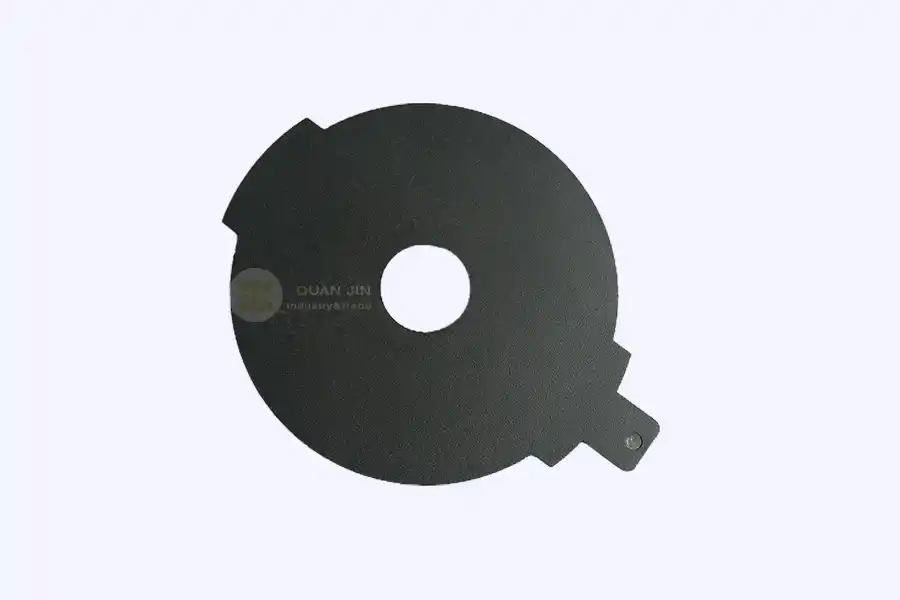
A RuO₂-coated titanium electrode is a titanium anode carrying a 5–15 µm ruthenium oxide–titanium dioxide layer that has been thermally decomposed onto a blasted, etched surface. That layer is what makes chlorine evolution fast; the titanium is what keeps the shape. It is the default anode for brine electrolysis, on-site hypochlorite, and seawater chlorination — and the wrong anode wherever oxygen evolution dominates.
What the coating actually is
Not paint, not a plating, and almost never pure ruthenium oxide.Start with a correction that matters at the purchasing desk: the dark gray-black layer on a ruthenium anode is not a film of pure RuO₂. Pure ruthenium oxide sinters badly on its own — it coarsens, loses surface area, and dissolves faster under oxygen evolution. What goes onto the titanium is a precursor mix of ruthenium chloride and a titanium alkoxide, typically at a 30:70 ruthenium-to-titanium molar ratio. Firing converts both into a single rutile-phase solid solution, with RuO₂ nanocrystals locked inside a TiO₂ matrix.
The titanium oxide is not inert filler. It holds the ruthenium crystallites apart, keeps them from growing during the next firing cycle, and anchors the layer to the substrate. Push the ruthenium fraction up and the coating gets faster but less stable; pull it down and you get a durable film that struggles to make chlorine. The 30:70 starting point is a compromise that has survived forty years of plant experience, and most commercial “ruthenium” anodes sit within ten points of it.
Why the surface looks cracked
Under a microscope, a good coating looks like a dried riverbed. That mosaic is not damage. Each coat is applied as a liquid precursor, dried, then fired; the film shrinks as solvent leaves and as chloride decomposes, and the shrinkage has to go somewhere. The cracks relieve stress and let electrolyte reach the buried active surface. What matters is their depth. Shallow cracks that stop inside the oxide are healthy. Cracks that run to the titanium let brine touch bare metal, and that is where passivation starts.
This is also why thickness alone tells you very little. A 12 µm film built from eight heavy coats has deeper mud cracks than a 12 µm film built from sixteen light ones, and it will usually die sooner. Coating quality lives in the number of cycles and the furnace profile, not in the micrometer reading.
Why ruthenium, not iridium
The thermodynamics say oxygen. The kinetics say chlorine. Ruthenium listens to the kinetics.Oxygen evolution is the easier reaction on paper. Its equilibrium potential is 1.23 V against 1.36 V for chlorine, so at any given cell voltage oxygen has a 130 mV head start. On most surfaces it wins, which is why ordinary anodes in brine make a disappointing mix of chlorine and oxygen.
RuO₂ reverses that. Chlorine evolution is a two-electron transfer with a low barrier on ruthenium sites, and in saturated brine at 60–80 °C the reaction runs at only 30–60 mV of overpotential at industrial current density. Oxygen evolution, a four-electron affair, needs several hundred millivolts more. The gap is wide enough that a ruthenium anode can hold 95 percent or better current efficiency for chlorine — until the conditions that favor oxygen start to pile up.
The gap in that chart is the whole business case for ruthenium, and also its vulnerability. Oxygen evolution does not just waste current. At the potentials where it runs, ruthenium is already going into solution as RuO₄, and every molecule that leaves takes catalytic surface with it. An anode that spends most of its life making oxygen is an anode being consumed by a side reaction, and no amount of extra coating fixes that — it only delays the invoice.
So the selectivity rules are worth memorizing, because they decide whether a ruthenium anode is the right purchase:
Substrate selection and forming
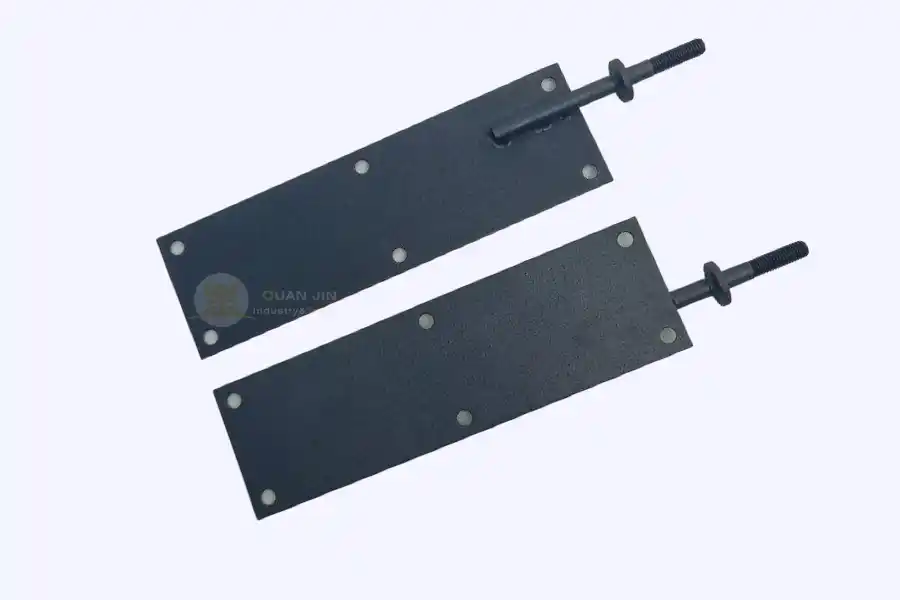
Grade 1 titanium for deep-drawn or expanded geometries, Grade 2 for plate and sheet. The metal is annealed, pickled, and formed before any coating work; bends and welds are finished first, because you cannot repair them afterward without destroying the oxide next to them.
Iron contamination is the quiet killer here. A plate that shared a rack with carbon steel, or was blasted with grit previously used on steel, will show rust-colored spots after etching and a coating that blisters in service.
Pretreatment: blast, then etch
Degrease, then blast with alumina to a uniform matte — typically 60–120 grit, enough to raise surface area without embedding grit. Then etch in 10–15 percent oxalic acid at 90–95 °C for one to three hours, until the surface turns an even light gray and stops fizzing.
This step removes the air-formed oxide and leaves a hydride-rich surface that the precursor can wet. Skip it, shorten it, or run it cold, and you get a coating that looks fine, passes a visual check, and lifts off in sheets six weeks into service.
Precursor preparation
Ruthenium chloride trihydrate and titanium butoxide are dissolved in n-butanol with a small hydrochloric acid addition to keep the ruthenium in solution. The mix is aged and filtered; undissolved particles become coating defects later, so a 1 µm filtration pass is cheap insurance.
Precursor concentration sets how much metal each coat deposits — usually 0.5–1.5 g/m² of ruthenium per pass. That is the knob used to hit a loading target without adding cycles.
Apply, dry, fire — repeatedly
Brush or roller application, dry at 100–120 °C to drive off solvent, then fire at 450–500 °C for several minutes per coat. Ten to twenty cycles build the film. Between coats the surface goes from dark brown to black as the chloride decomposes and the oxide crystallizes.
The furnace matters more than the recipe on paper. Above roughly 500 °C, ruthenium starts leaving as volatile RuO₄ — you lose metal you paid for, and the remaining film is ruthenium-poor. A 20 °C overshoot on a Friday afternoon shift is a real and common defect.
Final anneal and cooling
A one-hour anneal at the top of the firing window completes the rutile conversion and improves adhesion. Cooling rate is part of the specification: a fast quench in cold air puts the oxide in tension against a titanium substrate that contracts at a different rate, and the mud cracks open wider than they should.
Verification
X-ray fluorescence gives loading at several points per plate without touching the surface. Adhesion is checked by thermal shock or tape pull on a coupon. A sample from each batch goes into an accelerated life cell, and dimensions, flatness, thread condition, and weld quality are checked against the drawing.
Where it earns its keep — and where it does not
A short list, because most anode failures are selection failures wearing a coating-failure costume.| Service | What the anode sees | Fit | Watch out for |
|---|---|---|---|
| Membrane-cell chlor-alkali | Saturated brine, 80–90 °C, 1.5–2 kA/m² | Best fit | Brine purity; calcium and magnesium scaling on the back side |
| On-site hypochlorite from seawater | 1–3 kA/m², variable hardness, intermittent demand | Good | Hardness scaling; keep pH low; soft-start after idle periods |
| Pool and ballast-water chlorination | Low current, long idle stretches | Good | Dry-out and scale; never store with hypochlorite residue |
| Cathodic protection, seawater and soil | Very low current density, decades of duty | Good | Mechanical damage; cable seals; chlorine attack at the anode surface |
| Acid zinc, nickel, copper sulfate plating | pH 1–4 sulfate baths, chloride present | Workable | Fluoride and organic additives; current reversals in pulse plating |
| Hexavalent chrome plating | Strongly oxidizing chromic acid, oxygen evolution | Wrong tool | Coating consumed by OER; use lead-tin or platinized titanium |
| Ammonia and COD oxidation in wastewater | Low chloride, oxygen-dominant, fouling loads | Wrong tool | Ru dissolves; IrO₂–Ta₂O₅ is the durable choice |
| Copper foil and metal electrowinning | Sulfate electrolyte, high current, OER | Wrong tool | Same as above; coating life measured in months, not years |
The six failures you will actually see
Each one leaves a different fingerprint. Reading the fingerprint is faster than sending a sample to a lab.Voltage creeps up over years
Cell voltage rises slowly and steadily, 20–50 mV over a year, with no visible damage and no change in product quality. Pull the anode and the coating is thinner, uniformly gray, still adherent.
Meaning: normal consumption. Ruthenium leaves the surface at a rate set by current density and temperature.
Action: plan replacement on trend, not on failure; a voltage-based maintenance trigger beats a calendar.
A step change in the first few hundred hours
Voltage jumps 300 mV or more and stays there. The coating looks intact except for a small pale patch, often near a weld, a scratch, or an edge.
Meaning: bare titanium is exposed and has passivated to a TiO₂ film that blocks current.
Action: the patch is a manufacturing defect — a thin coat, a handling scratch, or a heat tint from welding. Raise it with the supplier with photographs and batch number.
Blistering along edges and welds
The coating lifts in flakes or bubbles at the perimeter, at bend radii, or beside welds, while the center of the plate is perfect.
Meaning: pretreatment failure. Grease, embedded blasting grit, or an oxide that was never fully etched.
Action: it will not heal. Replace, and ask for the etching bath concentration and time on the batch record.
High voltage at low current
Voltage is poor at low current and improves as current rises — the opposite of a coating problem, which gets worse with load. The anode surface looks normal.
Meaning: contact resistance. Titanium develops an insulating oxide at the busbar joint, the threaded rod, or the cable lug.
Action: clean and re-torque the connection; check for a star washer that has crushed through the oxide layer.
Coating gone in months
The layer disappears fast and evenly in a low-chloride, neutral-to-alkaline electrolyte. Voltage climbs, chlorine output falls, and the surface turns pale and chalky.
Meaning: oxygen evolution has taken over and is dissolving ruthenium. Fluoride in the bath accelerates it dramatically.
Action: switch to an iridium-based coating, or change the electrolyte chemistry. More ruthenium will not help.
Spalling after a shutdown
The coating lifts in sheets after a power interruption, a reversed connection, or a long idle period with electrolyte left in the cell.
Meaning: either cathodic polarization formed brittle titanium hydride under the coating, or residual hypochlorite attacked the substrate through the cracks.
Action: fix the rectifier polarity and interlock; rinse and dry before standby; never store a wet anode with chlorine on it.
Four of those six are not really coating failures. They are pretreatment, connection, or operating-envelope problems that show up at the coating because that is where the current crosses into the liquid. When an anode dies early, the useful question is not “who made this coating” but “what did this surface see that it should not have.”
Reading a life test without being fooled
A number in hours is only useful if you know what the cell was doing to the sample.
Almost every supplier quotes an accelerated life figure, and almost none of them are comparable. The standard test polarizes a small coupon at high current density in sulfuric acid until the voltage runs away — which measures how the coating behaves under oxygen evolution, not under chlorine. That is still useful: it is a harsh, repeatable stress that separates a well-built coating from a poorly built one. It is not a service-life prediction.
| It tells you | It does not tell you |
|---|---|
| Whether pretreatment and firing were consistent across a batch | How many years the anode will last in your cell |
| How one supplier’s coating compares with another’s under identical stress | How it behaves under chlorine evolution, scaling, or intermittent duty |
| Whether a process change made things better or worse | Whether the coating will survive your next shutdown |
| Whether a batch is an outlier before it ships | Anything at all about contact resistance or substrate quality |
Questions we get from plant engineers
Short answers, because the long ones are above.
What is the difference between a RuO₂-coated and an IrO₂-coated titanium electrode?
RuO₂ is faster for chlorine evolution and cheaper per square meter. IrO₂ survives oxygen evolution, low-chloride electrolytes, high current density, and current reversals. Choose ruthenium when chloride is abundant and pH is low; choose IrO₂–Ta₂O₅ when oxygen is the main reaction. The two are not interchangeable, and a mixed Ru–Ir coating is a compromise that suits some hypochlorite duty.
Does a heavier coating always mean a longer life?
No. Loading helps up to roughly 20–25 g/m² of ruthenium. Past that, each additional coat deepens the mud cracks and raises spalling risk faster than it adds catalytic capacity. Pretreatment quality and current distribution usually decide the outcome, not the last two grams.
Can I use it in seawater?
Yes, for electrochlorination and similar duty, provided pH is kept low enough to favor chlorine and hardness scaling is controlled. At high current density in warm seawater, oxygen evolution takes a larger share and wear accelerates. Soft-start after idle periods and regular acid cleaning add years.
What kills a ruthenium coating fastest?
Reverse current, fluoride in the electrolyte, running dry with chlorine or hypochlorite residue on the surface, and hot spots from poor contact or uneven flow. Normal consumption is slow. Those four turn a five-year anode into a five-month one.
How do I tell a dead anode from a scaled one?
Measure cell voltage at a fixed current, clean in dilute hydrochloric acid, and measure again. If voltage recovers, the problem was scale. If it does not, check contact resistance at the busbar before condemning the coating — a loose joint mimics a dead anode convincingly.
Send us your cell conditions
Chloride, pH, temperature, current density, and the geometry you need. We will come back with a coating family, a loading, and a voltage estimate — not a generic datasheet.